
 By
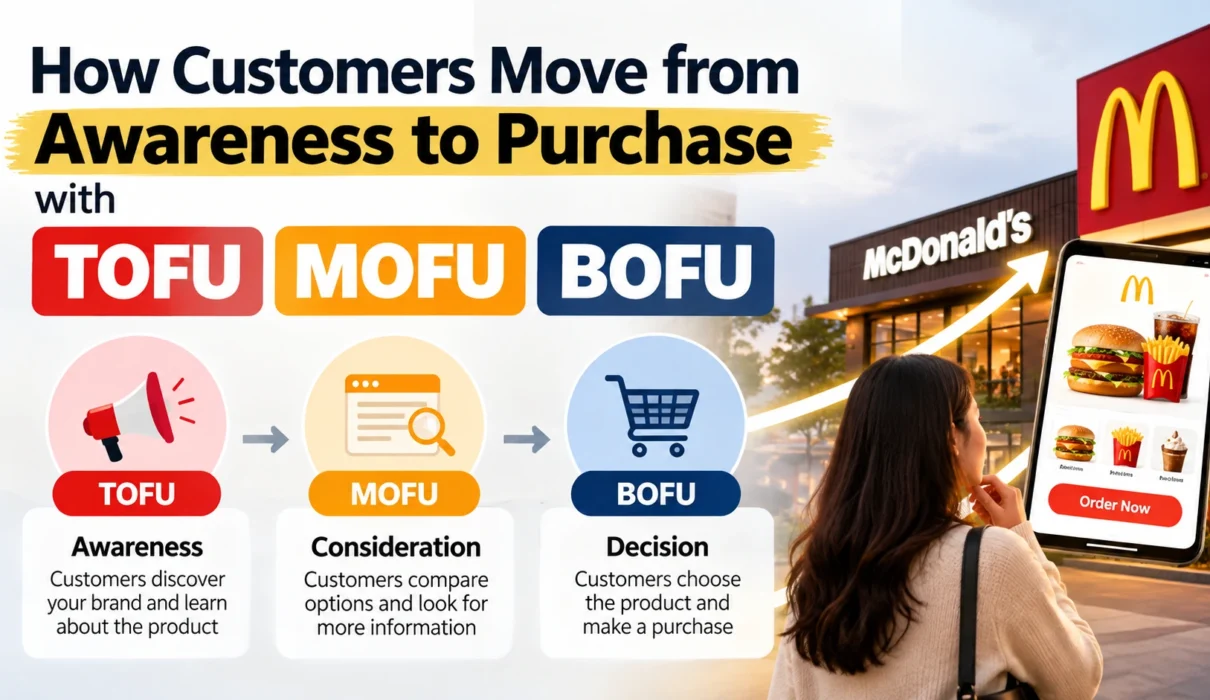
TOFU MOFU BOFU is a simple marketing framework that helps businesses understand how customers move from awareness to consideration and finally toward a purchase.
Most businesses today think that reaching more customers is enough to increase sales. However, customer reach is only one part of marketing. A person may see an advertisement, visit a website, or follow a brand on social media, but that does not mean they are ready to buy.
Before making a purchase, customers usually go through different stages. First, they become aware of a problem or product. Then, they learn more and compare different options. Finally, they decide whether they want to buy.
TOFU, MOFU and BOFU is a simple framework that helps businesses understand these different stages of customer buying behaviour. It helps marketers decide what to communicate, when to communicate it, and what action they want the customer to take.
What Do TOFU MOFU BOFU Mean?
The three terms stand for:
- TOFU — Top of the Funnel: Awareness
- MOFU — Middle of the Funnel: Consideration
- BOFU — Bottom of the Funnel: Decision/Conversion
The easiest way to understand them is:
TOFU gets attention → MOFU builds interest → BOFU encourages the decision.
The customer does not always move through these stages in a perfectly straight line. They may compare different brands, change their mind, or take time before buying. Still, this framework gives businesses a simple way to understand the customer’s position in the buying journey.
1. What is TOFU?
TOFU stands for Top of the Funnel means that the first thing use can do when they search a product.
It represents the awareness stage.
At this stage, the customer may not be ready to buy anything. They may simply be discovering a problem, learning about a product, or seeing a brand for the first time.
For example, someone may see a social media post about a new product. They may not purchase it immediately, but they now know that the product exists. This is the first step in the customer’s journey.
The main purpose of TOFU is to attract the right people and create awareness. Businesses usually provide useful or interesting information rather than immediately asking customers to buy.
This can include blogs, videos, social media posts, advertisements, guides, educational content, or awareness campaigns.
TOFU sells the knowledge first, not necessarily the product.
The idea is simple: first get the customer’s attention and create interest. The sale can come later.
2. MOFU — Middle of the Funnel
Now the customer knows more about the problem.
They are asking:
“Which solution should I choose?”
This is the consideration stage.
MOFU stands for Middle of the Funnel.
At this point, the customer is no longer just discovering the product. They are seriously thinking about their options. They may compare different brands, prices, features, quality, reviews, or benefits.
For example, if someone is planning to buy a smartphone, they may compare different brands and models before making a decision. They may watch reviews, read specifications, and ask other people for opinions.
This is where businesses need to provide information that helps customers make a better decision.
They can use comparisons, customer reviews, case studies, demonstrations, testimonials, detailed product information, and useful videos.
The main purpose of MOFU is to educate the customer, build trust, and help them understand why one solution may be suitable for them.
3. BOFU — Bottom of the Funnel
BOFU stands for Bottom of the Funnel.
This is the decision stage.
At this point, the customer already knows about the product and has considered different options. They are now much closer to taking action.
The customer may want to know the price, available offers, product details, reviews, payment options, delivery information, or how they can actually purchase the product.
This is where the business should make the final decision as simple as possible.
Businesses can use pricing information, offers, product demonstrations, testimonials, free trials, easy ordering processes, and clear calls to action such as “Buy Now,” “Order Now,” “Book a Demo,” or “Sign Up.”
The main purpose of BOFU is to convert an interested customer into an actual customer.
How McDonald’s Uses TOFU MOFU BOFU
A simple way to understand the complete concept is to look at a familiar brand such as McDonald’s.
Imagine a person who has not planned to eat at McDonald’s.
TOFU — Awareness
The person sees a McDonald’s advertisement on Instagram, YouTube, television, or a billboard. The advertisement may show a burger, fries, a new product, or a special campaign.
The person may not immediately go to McDonald’s. However, the advertisement has created awareness and made the person remember the brand.
The customer may think: “That looks interesting.”
This is TOFU because the main purpose at this stage is to get attention and create awareness.
MOFU — Consideration
Later, the person becomes hungry and starts thinking about what to eat. Since they already know McDonald’s, they may now look at the menu, check different meal options, see prices, look at offers, or compare different food choices.
Now the customer is thinking: “What should I order?”
The customer is considering the available options. This is MOFU.
At this stage, information about the products, menu, offers, reviews, and choices can help the customer decide what is suitable for them.
BOFU — Decision
Finally, the customer decides to eat at McDonald’s. They open the app or website, select a meal, check the final price, and place the order. They may also visit the restaurant directly.
Now the customer is thinking: “I know what I want. I’ll order it.”
This is BOFU because the customer is taking the final action. So the complete journey can be understood as:
Advertisement → Awareness → Consideration → Decision → Purchase
This simple example shows that marketing is not only about showing advertisements. The business needs to understand what the customer needs at each stage of the buying journey.
How a Business Student Can Actually Use TOFU MOFU BOFU
This is the point where the framework starts to come in handy for an MBA or marketing student.
Let’s say your assignment is: “Create a digital marketing plan for a nearby coffee shop.” Don’t write: “The coffee shop should utilize Instagram.” But use the funnel instead to find out about the needs of the clients at different stages.
Step 1: Identify the target customer
Example:
Target segment:
18–30-year-old college students and young professionals.
The first step is to clearly identify who the business wants to reach. A cafe targeting college students may communicate differently from a cafe targeting families or corporate professionals.
Knowing the target customer makes it easier to understand their needs, interests, budget, habits, and buying behaviour.
Step 2: Identify their questions
Awareness questions that help to understand customer preference.
- Where can I find a good cafe near me?
- What makes a cafe a good place for studying?
- How to find budget cafes?
- These are TOFU questions because the client is only researching.
- Consideration questions
- Cafe A or Cafe B?
- Where is there free Wi-Fi?
- Where is there a better atmosphere?
- What do they have on their menu?
- What are the prices?
- Is there any place to sit?
- How do I make a reservation?
These are BOFU questions, and the customer is about to make a choice.
Step 3: Create Content for Each Stage
| Funnel | Cafe marketing example |
| TOFU | “5 Best Things to Look for in a Study Cafe” |
| TOFU | “How to Choose a Cafe for Remote Work” |
| MOFU | “Our Cafe vs Typical Coffee Shops: Menu & Facilities” |
| MOFU | Customer reviews and ambience videos |
| BOFU | Menu + prices |
| BOFU | Reservation page |
| BOFU | Special offer |
| Conversion | “Reserve Your Table” |
The important thing is that each piece of content has a purpose.
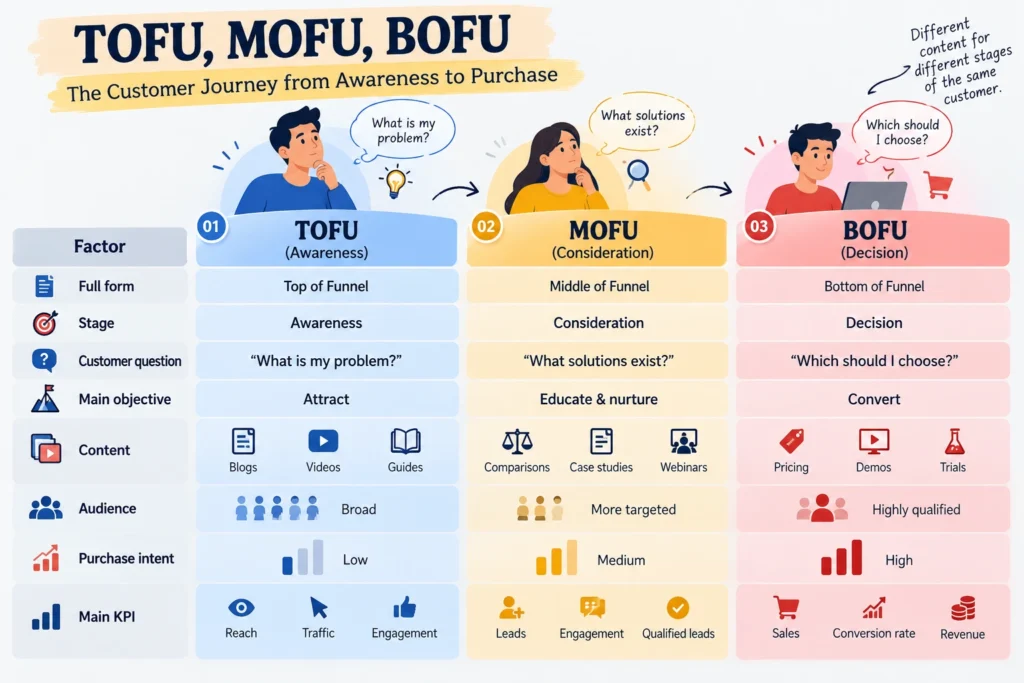
TOFU content is designed to attract people and help them discover the business or the problem. MOFU content gives them more information and helps them compare their options. BOFU content removes the final doubts and makes it easier for them to take action.
Now you’re thinking like a marketer rather than simply creating social media posts.
The real question is not:
“How many people can we reach?”
It is:
“Where is the customer in their buying journey, and what do they need from us right now?”
That is the real value of TOFU, MOFU and BOFU.