
 By
By In a world where consumers are surrounded by advertisements, simply being visible is no longer enough. Brands need to be interesting, surprising, and memorable.
This is where guerrilla marketing enters the picture.
Guerrilla marketing is an unconventional marketing approach that uses creativity, surprise, public interaction, and word-of-mouth to generate attention. Unlike traditional advertising, which often depends on large media budgets, guerrilla marketing attempts to make a relatively small action feel much bigger.
The central idea is simple:
Don’t just advertise to people. Give them something worth talking about.
Why Word-of-Mouth Matters
The effectiveness of guerrilla marketing is closely connected to one of its biggest advantages: earned attention.
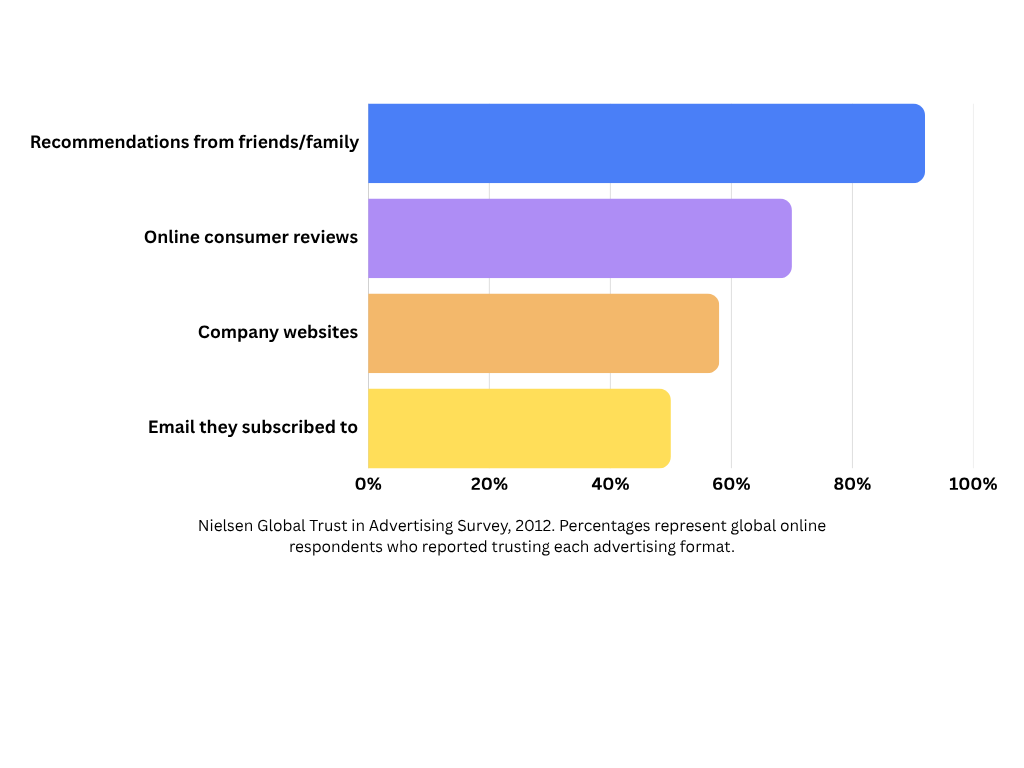
Nielsen’s Global Trust in Advertising research found that 92% of global consumers surveyed in 2012 trusted recommendations from friends and family more than other forms of advertising. Online consumer reviews were also highly trusted, at 70%.
Nielsen’s research examines which forms of advertising consumers trust most, including recommendations from friends and family and online reviews. It supports your discussion about why word-of-mouth and earned attention are important in guerrilla marketing.https://www.nielsen.com/insights/2012/global-trust-in-advertising-and-brand-messages-2/
A clear marketing strategy helps businesses connect creative guerrilla campaigns with their broader objectives, target audience, and competitive positioning. https://knowledgestacker.com/swot-analysis-complete-guide-with-examples/
Graph 1: What Consumers Trusted Most
A Unique Guerrilla Marketing Concept: “The Mystery Trail”
One innovative guerrilla marketing approach is Mystery Trail. Let’s take the case of a new cafe in a crowded part of town. Instead of advertising in the usual way, the cafe started a game it makes a number of clues for customers to find. The first advertisement reads: “Something delicious is close by. Can you find it?” Using a QR code, customers lead themselves to clue two. This clue will take them somewhere near the cafe. The third clue is a puzzle. The last clue brings customers to the cafe, where they will receive a small gift. Thus, the campaign effectively turns a simple marketing message into an exciting quest.
Why the Mystery Trail Works
The concept combines five powerful elements:
| Element | What it creates |
| Surprise | Immediate attention |
| Curiosity | Desire to discover more |
| Participation | Emotional involvement |
| Reward | Motivation to complete the experience |
| Shareability | Organic word-of-mouth |
This creates a potentially powerful cycle:
Attention → Interaction → Emotion → Sharing → Reach
That is the real strength of guerrilla marketing.
Real-Life Example: Coca-Cola’s “Happiness Machine”
The concept of experiential marketing can be demonstrated by one of the foremost examples of marketing of this type – Coca-Cola’s Happiness Machine.
A simple vending-machine transformed at St. John’s University by Coca-Cola became a source of unexpected surprises. The vending machine was vending much more than just Coca-Cola – some extra Coca-Cola products and other surprises.
The responses of people were filmed and posted later.
WARC provides a case study of Coca-Cola’s Happiness Machine campaign and its approach to creating an unexpected consumer experience. This is a useful source for supporting the real-life guerrilla and experiential marketing example in your article.https://www.warc.com/en/article/coca-cola%3A-the-happiness-machine-cbfe927f2b0a49f78736c31ca4496b8a
Stanford Graduate School of Business materials say that the budget of the project was reported to be $50,000, which included the cost of labour, props, and film. The video made reached 1 million views in YouTube within 10 days and more than 2 million views within two months.
As the case study of WARC says, the project got 1 million views within 12 days and 3 million views by the end of the year with the explanation that the campaign was done without the traditional approach to media-intensive campaigns.
Graph 2: Happiness Machine — Reported View Growth

From Advertisement to Experience
Traditional advertising often follows this model:
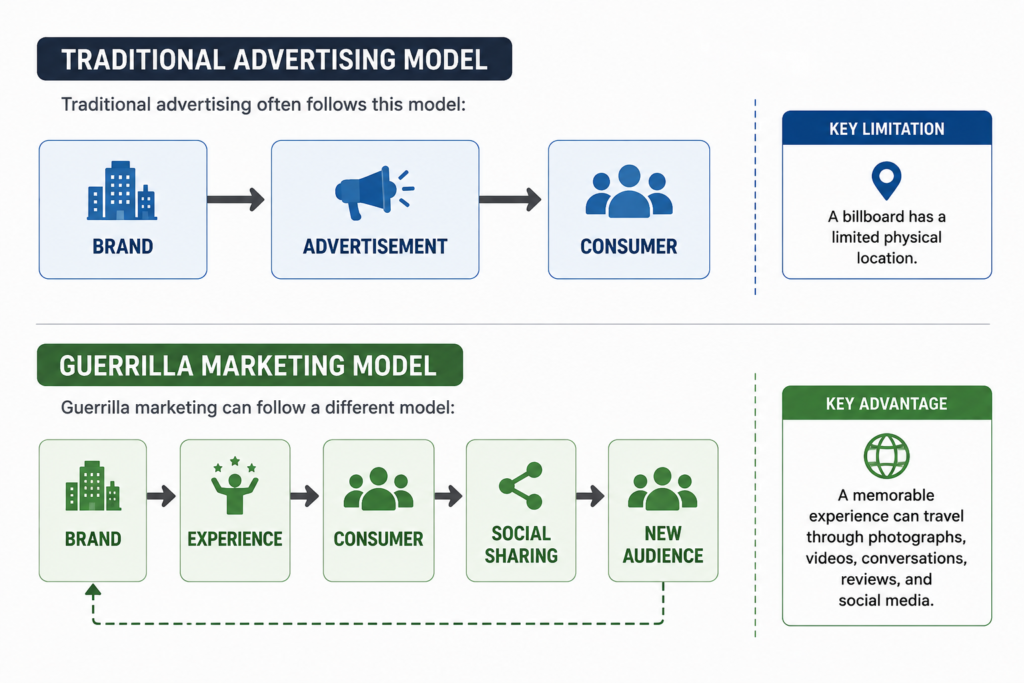
Brand → Advertisement → Consumer
Guerrilla marketing can follow a different model:
Brand → Experience → Consumer → Social Sharing → New Audience
That difference is extremely important.
A billboard has a limited physical location.
A memorable experience can travel through photographs, videos, conversations, reviews, and social media.
This is why guerrilla campaigns can sometimes generate an impact much larger than the physical space in which they begin.
Guerrilla Marketing in Real Life
Guerrilla strategy is not only for multinational corporations. Small firms can also use this approach.
1. Cafes and Restaurants
A coffee shop could run a “hidden menu” plan where customers search for clues around the town that would lead to an unusual beverage. The customers who found the last clue could get the drink at a great price.
The outcome of this strategy is:
- lots of traffic,
- raised curiosity,
- creation of social content,
- involvement of clients,
- advertisements via word-of-mouth.
2. Clothing Brands
A fashion company may use an interactive mirror in a busy area. The mirror does not simply display ads, but it allows clients to take their photos in virtual clothing.
The client will get a photo with the brand name and logo.
In such a way a client becomes an advertiser.
3. Gyms
A gym may hold a 60-second fitness competition in the streets. The results may appear on the digital screen in real-time.
The clients may get a bonus for participation.
The ad turns from:
“Take our membership”
into:
“Are you able to beat the score?”.
4. Schools and Universities
A university may have a university-wide treasure hunt.
All clues will teach students about a subject or department.
Students who finish will receive a token prize.
This way information becomes an experience.
5. New Ventures
Startups can possibly use guerrilla advertising against bigger competitors with larger marketing budgets than theirs.
For example, a startup in the field of technology can organize a demonstration of the product at some permitted open location.
They are not after beating the major corporation in the advertising expenditures.
They just want to think cleverer.
Measuring Guerrilla Marketing
Creativity should not mean ignoring measurement.
A campaign can be evaluated using a simple framework:
The Guerrilla Marketing Impact Score
Impact = Attention + Participation + Sharing + Conversion
The impact of a campaign is defined by the combination of Attention, Participation, Sharing, and Conversion.
An example of how a business can track the impact of a promotional campaign may include:
- The number of people who viewed the campaign
- The number of QR codes scanned
- The number of participants
- The number of mentions in social networks
- The number of user-generated posts
- The number of website visits
- The number of redeemed coupons
- The number of new clients
- The amount of income generated from the campaign
A campaign that has reached 100,000 people without any real actions from customers may offer less value than a press release that reached 10,000 people who were relevant to the product class and had taken some actions after seeing the message.
Thus, in this case, the question should not be, “How many people saw it?” But rather, “What did people do after they saw it?”
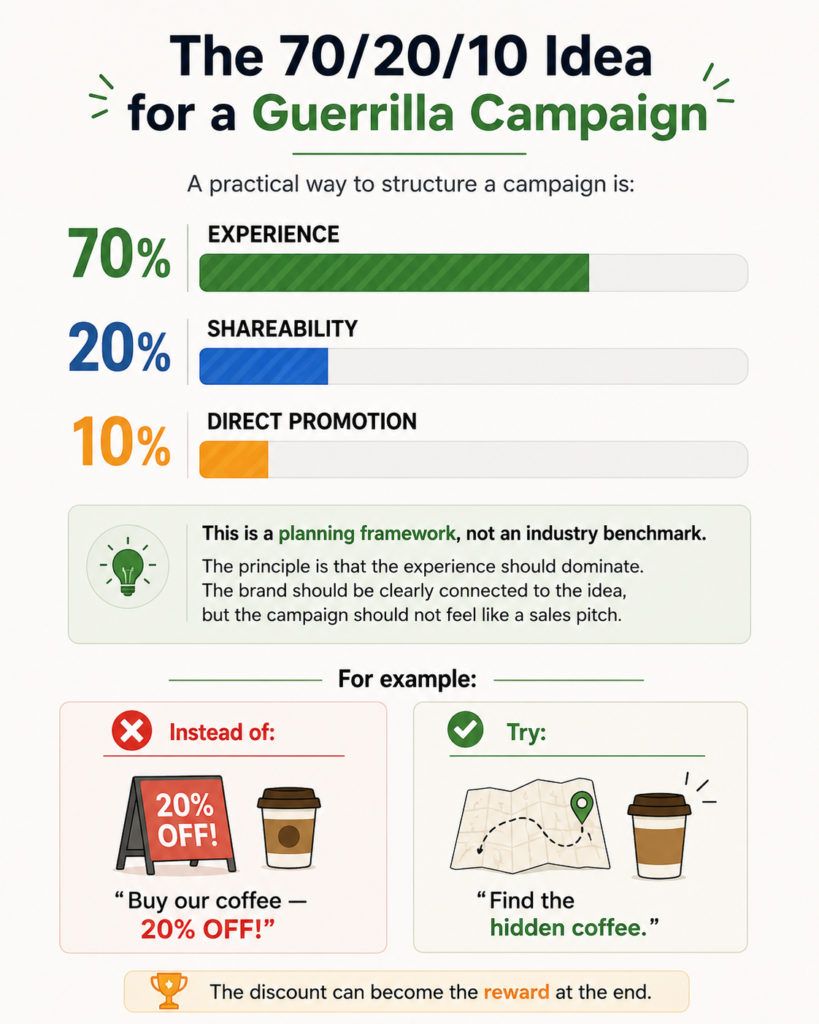
The 70/20/10 Idea for a Guerrilla Campaign
What Makes a Guerrilla Campaign Go Viral?
There are no tried and tested formulas for achieving virality. Nonetheless, successful campaigns tend to feature some of the following elements in them:
1. Surprise
We tend to stop paying attention when something surprise happens to us.
2. Emotion
Different emotions such as happiness, curiosity, and excitement are the main reasons we share any content.
3. Simplicity
The idea should be simple to understand.
4. Visual Element
The campaign should have an element of photo or video capturing so that it easily spread to other places.
5. Brand Connection
The campaign has to be relevant to the brand.
6. A Reason to Share
People should have something that is worth sharing.
For instance, Coca Cola’s Happiness Machine shows these principles perfectly. The experience produced was so engaging that it can be useful both offline and online.
Conclusion
Guerrilla marketing emphasizes an essential notion that marketing has recognized today:
Some attention does not require money to buy. Sometimes, it must be gained.
Creativity can go a long way for small businesses; they can put their full potential to create a successful marketing campaign utilizing a common space, once offering a new experience.
Most effective guerrilla marketing campaigns achieve three objectives:
They make people stop.
They make people react.
They give people the reason to tell about it.
As a result, guerrilla marketing can produce a chain of events, which goes beyond the marketing campaign:
CREATIVE IDEA
↓
SURPRISE
↓
PARTICIPATION
↓
EMOTION
↓
SOCIAL SHARING
↓
WORD-OF-MOUTH
↓
BRAND AWARENESS
↓
CUSTOMER ACTION
In a market with too much noise, guerrilla marketing suggests a different approach of making noise by generating an unforgettable event.
Moreover, in some cases, the best kind of advertising does not look like an advertisement at all; therefore, it creates an impactful experience.