

 By
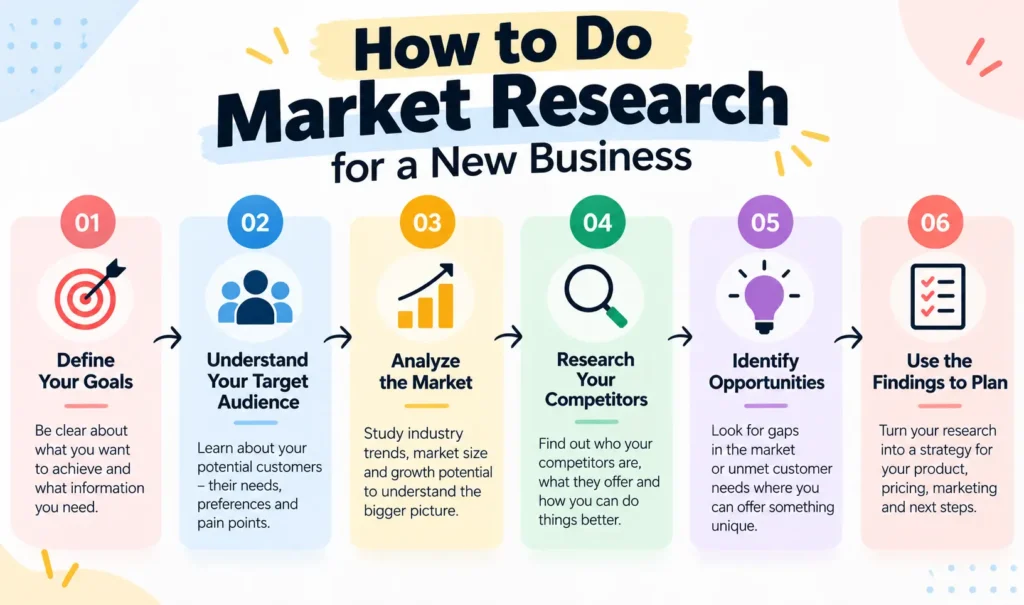
Market research is a very essential part of starting a new business or launching a new product or brand. Market research for a new business means finding out something useful for your business. Before you spend money, you need to understand whether enough people have a real problem, whether they will pay to solve that problem, and whether you can reach them affordably. Work through five points in order to analyse market potential and pain points: market size, competitors, customer interviews, a small paid test, and a go/pivot/stop decision. Most first-time founders can complete all five points in two weeks for under $500.
Most businesses don’t fail because the product is bad. They fail because nobody checked whether enough people wanted it or whether the product could really solve people’s pain points. CB Insights’ recurring analyses of startup post-mortems have repeatedly ranked “no market need” among the top reasons startups shut down, and it’s the one cause you can test for before you build anything.
This guide gives you a process instead of a set of tools. We call it the Research Stack: five points, each resting on the one below it. By the end, you’ll have a numbers-backed answer to one question: Should I build this?
Helps explore search interest over time and compare interest in products, services, and customer problems.https://trends.google.com/trends/
Learn how to evaluate a business’s strengths, weaknesses, opportunities, and threats to make better strategic decisions.https://knowledgestacker.com/swot-analysis-complete-guide-with-examples/
In this guide
- The Research Stack at a glance
- 1: Size the market
- 2: Map the competitors
- 3: Talk to real customers
- 4: Run a small paid test
- 5: Make the decision
- A worked example
- Common mistakes
- Key takeaways and FAQ
The Research Stack at a glance
| Layer | Question it answers | What you walk away with |
| 1. Size | Is the market big enough? | A bottom-up market size estimate |
| 2. Compete | Who else serves this need, and how well? | A competitor map with gaps |
| 3. Talk | Is the problem real and painful? | 10-15 interview notes and patterns |
| 4. Test | Will people actually pay? | Sign-up and pre-order data |
| 5. Decide | Go, pivot, or stop? | A scored decision with evidence |
Run the layers in order. Each one is cheaper than the next, so you find fatal problems early, when they cost the least.
1 Size the market
Goal: Find out whether there are enough potential customers to support a real business. Find out how many people can buy this type of product.
Three terms come up constantly:
- TAM (total addressable market): Total market demand for a product or service.
- SAM (serviceable available market): the part of the TAM, specialized or limited market demand for a product or service.
- SOM (serviceable obtainable market): how many customers could realistically benefit from buying your product or service.
Use bottom-up approach : Top-down says “the global pet industry is worth $X billion, and we’ll take 1%.” Investors and experienced founders not believe in top down approach because 1% of a huge number is a guess analysis. Bottom-up approach builds the things that you can count
2 Map the competitors
Understand who already serves your customers, and where they leave gaps.
Competitors is not usually a warning or not good news. It often means no one has found a profitable market there. Start by listing three kinds:
- Direct competitors: same product, same customer.
- Indirect competitors: a different product solving the same problem.
- The status quo: spreadsheets, hiring a freelancer, or doing nothing. This is often your biggest competitor.
For each competitor, collect the same information in a simple table.
| Field | Where to Look |
| Price and Pricing Model | Check their pricing page to see how much they charge and how their plans work. |
| Target Customer | Look at their homepage, customer stories, and case studies to understand who they serve. |
| Main Promise | Read the headline and the first section of their website to understand what they promise customers. |
| Weaknesses | Read 1-star and 2-star reviews on G2, Capterra, Trustpilot, app stores, and Reddit to find out what customers dislike. |
| Company Size and Funding | Check Crunchbase and LinkedIn to learn about their funding and team size. For public companies, check SEC EDGAR filings at sec.gov/edgar. |
| Search Presence | Explore their blog and check whether they are running ads to understand how they attract customers. |
The most important part of competitor research is reading customer complaints.
Bad reviews are a free source of customer feedback. If you notice the same complaint in 20 different reviews, you may have found a problem that your business could solve.
After your research, write one clear sentence:
“Unlike [competitor], we [specific difference] for [specific customer].“
If you cannot complete this sentence with a clear and meaningful difference, keep researching before moving forward.
3 Talk to Real Customers
Find out whether the problem is real, happens often, and is painful enough that people are already spending time or money trying to solve it.
Surveys can be useful, but customer interviews are usually more helpful when you are just starting. They allow you to ask follow-up questions and learn things you did not expect.
Try to have 10–15 conversations with people who fit your target customer group. Each conversation should last around 20–30 minutes.
You can find people through LinkedIn, relevant Reddit and Facebook groups, local business owners, and friends of friends. Avoid interviewing close friends and family because they may be too supportive and less honest about your idea.
Ask the right questions
Rob Fitzpatrick explains this approach in his book The Mom Test. The main idea is simple: ask people about their real experiences and past actions, not whether they like your idea.
People may say your idea sounds great just to be polite. But what they have actually done in the past gives you much more useful information.
Questions worth asking:
- “Tell me about the last time you faced [problem].”
- “What did you do to solve it?”
- “What have you tried so far, and how much did it cost?”
- “What is the most frustrating part of this problem?”
- “Who else is involved in making decisions about this?”
Questions to avoid:
- “Would you use a product that does X?” Almost everyone may say yes, even if they never actually use it.
- “Do you think this is a good idea?” People may give you a positive answer just to be nice.
- “How much would you pay?” People often guess incorrectly. It is better to test real prices in Layer 4.
4 Run a Small Paid Test
Find out whether people who do not know you are willing to take a meaningful action. This is a much stronger signal than simply saying they like your idea.
Here are three low-cost ways to test demand, starting with the easiest and moving toward the strongest.
1. Test a landing page
Create a simple one-page website that includes:
- A clear headline explaining your offer.
- Three main benefits.
- The price of your product or service.
- An email sign-up form or a “Join the Waitlist” button.
Bring visitors to the page using a small advertising budget of $100–$300 on Google, Meta, or LinkedIn. You can also share the page in relevant online communities.
2. Offer a pre-sale or deposit
Ask interested customers to pay a refundable deposit or place a pre-order.
Even if someone pays just $10, it tells you much more about their interest than simply signing up for an email list.
3. Offer the service manually
Before building software or automating everything, deliver the result yourself to 3–5 customers.
If these customers pay for the service and come back for more, it is a good sign that your offer may have real demand.
What should you measure?
Track these three things:
- Sign-up rate: What percentage of visitors sign up?
- Cost per sign-up: How much money do you spend to get each sign-up?
- Conversion to payment: How many people who sign up go on to pay a deposit or join a paid pilot?
Many founders consider a 5–10% sign-up rate from well-targeted traffic a promising early result. However, this is only a general guideline, not a fixed rule. Results can vary significantly depending on the industry and where the visitors come from.
Focus on comparing your own tests over time instead of trying to match someone else’s numbers.
Remember: Small tests can give misleading results. For example, a test with 200 visitors may make an idea look better or worse than it really is. Treat the result as one piece of evidence, and repeat the test with a different message before investing your savings.
5 Make the Decision
Now that you have collected your research, it is time to decide whether your business idea is worth pursuing.
Score each area from 1 to 5, where 1 means weak and 5 means strong. For every score, write one short line explaining the evidence behind it.
| Area | Score (1–5) |
| The market is large enough (Layer 1) | |
| There is a clear gap between your offer and competitors (Layer 2) | |
| The problem is painful and happens frequently (Layer 3) | |
| People have paid or made a real commitment (Layer 4) | |
| You can reach customers at an affordable cost |
How to understand your scores
Go ahead: If most of your scores are 4s and 5s and you have real evidence that people are willing to pay, start building the smallest useful version of your product.
Make a change: If the problem is serious but people are not paying or you cannot reach them affordably, consider changing your target customer, pricing, or offer. Then repeat Layers 3 and 4.
Stop or put the idea on hold: If several areas score poorly, it may be better to walk away or revisit the idea later. Finding out early that an idea will not work can save you months of effort and money.
These scores are meant to help you think clearly, not make the decision for you. Use your judgment and write down why you decided to move forward, make changes, or stop. This will help you learn from the process.
A Worked Example of market Research for a New Business
The following is a hypothetical example with made-up numbers. Use your own research and data when testing a real business idea.
Business idea: A simple bookkeeping tool for freelance graphic designers in the United States.
1 Estimate the market size
Suppose public employment data and industry sources suggest that around 400,000 graphic designers work as freelancers.
If the tool costs $15 per month, or $180 per year, the estimated Total Addressable Market (TAM) would be:
400,000 × $180 = $72 million per year
If you could realistically reach 10% of these customers through online channels, your Serviceable Available Market (SAM) would be around $7.2 million per year.
If you captured 3% of that market within three years, your annual revenue would be around $216,000.
This suggests the idea could become a small, sustainable lifestyle business rather than a large venture-scale company. That is perfectly fine, as long as you understand what you are aiming to build.
2 Study the competition
Existing general accounting tools already serve this market.
After reading their reviews, suppose you find that several designers complain about unnecessary features and confusing tax categories.
This could reveal an opportunity to build a simpler tool focused only on invoicing and quarterly estimated taxes.
3 Interview potential customers
Suppose you interview 12 freelance graphic designers and discover that:
- 8 track their finances using spreadsheets.
- 5 have missed a tax payment at least once.
- 3 already pay for a bookkeeper.
These findings suggest that the problem is real and that some customers are already spending money to solve it.
4 Test whether people will pay
You create a landing page offering the tool for $15 per month and ask visitors to place a refundable $10 deposit.
The page receives 220 visitors, resulting in 19 sign-ups and 4 deposits.
This gives you early evidence that some people are interested enough to make a financial commitment.
5 Make the decision
Suppose your scores are 3, 4, 5, 4, and 3 across the five areas.
Your decision is to move forward carefully. Build a basic version for the four people who placed deposits, then check whether you can attract more customers at an affordable cost before investing further.
Common Mistakes to Avoid
- Asking only people who like you: Friends and family may give overly positive feedback because they want to support you.
- Looking only for evidence that supports your idea: This is confirmation bias. Actively search for reasons your idea might fail, too.
- Depending only on large market estimates: Saying “We only need 1% of a huge market” is not a real business plan. You need a practical way to reach and win customers.
- Mistaking compliments for demand: Praise is easy to give. Spending time, paying money, or making a real commitment is much stronger evidence.
- Stopping at online research: Reports and articles explain what has happened in the past. Interviews and real-world tests help you understand what customers may do next.
- Ignoring what customers currently do: Your biggest competitor may not be another company. It could be the customer’s current workaround or simply doing nothing.
Evidence Rating for This Guide
Evidence strength: Moderate (yellow).
This process is based on widely used startup research methods, including bottom-up market sizing, customer interviews, and small-scale demand tests.
Public data can provide a solid starting point for estimating market size. However, there is limited rigorous research comparing how well different validation methods predict startup success.
Treat the suggested numbers and scoring thresholds as helpful guidelines rather than proven rules.
Key Takeaways
- Research the market before building your product. Start with the cheapest methods and move toward more expensive tests.
- Estimate market size using the number of customers you can realistically identify and reach, rather than relying on a percentage of a huge market.
- Read competitors’ negative reviews to discover problems that are not being solved well.
- Ask customers about their past experiences and behavior instead of asking whether they like your idea.
- Trust real actions, such as deposits and pre-orders, more than verbal promises.
- Remember that finding out early that an idea will not work is still a successful outcome because it saves you time and money.
Frequently Asked Questions that helps market research for a new business
How much does startup market research cost?
You can complete a useful first round of research for less than $500. Public data is often free, customer interviews mainly cost your time, and a small advertising test may cost $100–$300.
Paid industry reports can cost thousands of dollars, but you rarely need them at the beginning.
How long should market research take?
Plan for around two focused weeks for your first round of research.
Customer interviews and paid tests usually take the longest because you need to schedule conversations, attract visitors, and wait for people to respond.
How many customer interviews are enough?
Many founders start noticing repeated patterns after around 10–15 interviews and may reach a point where new conversations reveal little new information.
However, if people’s answers continue to vary widely, your target customer group may be too broad. You may need to narrow it down and interview a more specific group.
Do I need market research if I am starting a small local business?
Yes, but you can keep it simple.
Count the competitors in your area, compare their prices and customer reviews, and talk to around 10 potential customers.
The same five layers of research still apply, but you can use a smaller and more practical approach that fits your business.