

 By
Understanding Mutual Funds, Their Types, Structure and Investment Options
1. Introduction to Mutual Funds
A mutual fund is an investment vehicle that collects money from a large number of investors and invests that money in securities such as shares, government securities, corporate bonds, money-market instruments and other permitted assets. Instead of selecting and monitoring every investment independently, investors participate in a professionally managed portfolio according to the scheme’s investment objective.
If you want to learn about Mutual fund then visit our blog. https://knowledgestacker.com/mutual-funds-understanding-the-basics/
Learn about how mutual fund works then go to the below website.https://www.amfiindia.com/research-information
How a Mutual Fund Works:
Investor → Money Invested → Mutual Fund Scheme → Fund Manager → Securities → Returns to Investors
| Benefit | Explanation |
| Diversification | Money is spread across different securities, reducing dependence on one investment. |
| Professional Management | Investment decisions are made according to the scheme’s stated objective. |
| Liquidity | Many open-ended schemes allow regular purchase and redemption, subject to scheme terms. |
| Accessibility | Investors can invest through SIPs or lump-sum investments. |
| Transparency | Mutual funds provide scheme, portfolio, NAV and expense-related disclosures as required. |
| Variety | Investors can choose among equity, debt, hybrid and other schemes. |
2.Classification of Mutual Fund
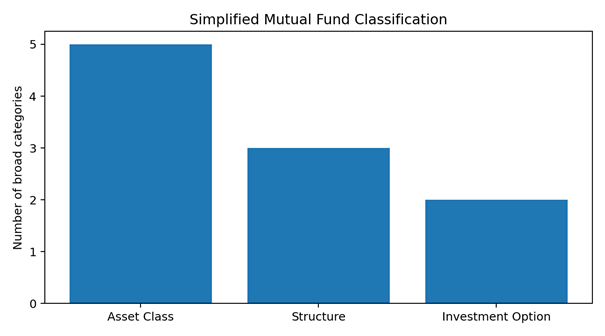
Mutual funds can be understood using three broad bases: asset class, structure and investment option.
| Basis | Categories |
| Asset Class | Equity, Debt, Hybrid, Solution-Oriented and Other Schemes |
| Structure | Open-Ended, Closed-Ended and Interval |
| Investment Option | Growth and IDCW |
Regulatory Classification: The Market Cap Framework
An equity mutual fund pools capital from multiple retail and institutional investors to construct a diversified portfolio primarily composed of equity shares and equity-linked instruments. By holding a slice of many different businesses across industries, the fund allows individuals to participate in corporate growth and equity returns without having to select, research, and monitor individual stocks themselves.
Under SEBI regulations, listed companies are categorized based on their full market capitalization to ensure uniformity across fund houses:
- Large-Cap: 1st to 100th company by market capitalization.
- Mid-Cap: 101st to 250th company by market capitalization.
- Small-Cap: 251st company onwards.
Equity fund categories are defined by how strictly they allocate their assets across these tiers and the strategies they execute.
Comprehensive Breakdown of Equity Mutual Fund Types
1. Market Capitalization-Based Funds
- Large-Cap Funds
- Mandate: Must invest at least 80% of total assets in large-cap companies.
- Characteristics: These invest in established industry leaders (blue-chip firms) with proven track records, solid balance sheets, and strong corporate governance.
- Risk & Horizon: Lowest volatility among pure equity funds. Suitable for conservative equity investors seeking steady capital appreciation over 3–5 years.
- Mid-Cap Funds
- Mandate: Must invest at least 65% in mid-cap companies.
- Characteristics: Mid-sized businesses that often operate in high-growth phases, aiming to scale into large-caps. They offer faster earnings growth potential than mature giants but face higher market volatility and cyclical drawdowns.
- Risk & Horizon: Moderately high risk; best suited for an investment horizon of 5–7 years.
- Small-Cap Funds
- Mandate: Must invest at least 65% in small-cap companies.
- Characteristics: Businesses in nascent or niche industries with low institutional ownership. While they offer substantial multi-bagger upside during economic expansions, they carry substantial business, liquidity, and governance risks during downturns.
- Risk & Horizon: High risk with sharp drawdowns; requires a horizon of 7+ years to absorb market cycles.
- Large & Mid-Cap Funds
- Mandate: Minimum 35% in large-caps and minimum 35% in mid-caps simultaneously.
- Characteristics: Offers a structured blend: large caps provide downside support and liquidity, while mid caps supply portfolio acceleration.
- Risk & Horizon: Balanced growth profile suitable for 5+ years.
2. Diversified & Multi-Cap Strategies
- Flexi-Cap Funds
- Mandate: Minimum 65% in equities, with complete freedom to invest across large, mid, and small-cap stocks in any proportion at any time.
- Characteristics: The fund manager dynamically shifts exposure depending on market valuations and macroeconomic conditions—moving defensive into large caps when markets are frothy, or aggressive into mid/small caps during recoveries.
- Risk & Horizon: Moderate to high; widely used as a core portfolio anchor for a 5+ year horizon.
- Multi-Cap Funds
- Mandate: Minimum 75% overall equity, with mandatory minimum allocations of 25% in Large-Caps, 25% in Mid-Caps, and 25% in Small-Caps.
- Characteristics: Unlike flexi-cap funds, the manager cannot eliminate small- or mid-cap exposure, ensuring guaranteed structural diversification across all tiers regardless of market sentiment.
- Risk & Horizon: High volatility driven by the fixed 50% combined mid- and small-cap floor.
3. Strategy & Theme-Driven Funds
- Value Funds & Contra Funds
- Mandate: Minimum 65% in equities. A fund house can offer either a Value or a Contra fund, not both.
- Characteristics:
- Value Funds seek out intrinsically sound companies trading at a discount to their fair value due to temporary headwinds (low P/E or low P/B multiples).
- Contra Funds take contrarian bets, investing against prevailing market consensus in sectors or companies that are currently out of favor.
- Risk & Horizon: High patience requirement; value traps can take years to re-rate. Horizon: 5–7 years.
- Focused Funds
- Mandate: Minimum 65% in equities, with a statutory cap of maximum 30 stocks.
- Characteristics: High-conviction portfolio that abandons broad diversification. If selected stocks perform well, alpha generation is significant; however, company-specific missteps hit portfolio NAV much harder.
- Risk & Horizon: High; heavily dependent on fund manager stock-picking accuracy.
- Sectoral and Thematic Funds
- Mandate: Minimum 80% in a specific sector (e.g., Banking, Technology, Pharma) or a broader theme (e.g., Infrastructure, Manufacturing, ESG).
- Characteristics: Highly concentrated. These lack sector-level diversification and are tightly bound to cyclical trends. If the chosen sector enters a prolonged slowdown, the fund will struggle regardless of broader market gains.
- Risk & Horizon: Very high; typically recommended only for tactical, cyclical allocations by experienced investors.
- Dividend Yield Funds
- Mandate: Minimum 65% in dividend-yielding stocks.
- Characteristics: Targets businesses with high cash generation that consistently distribute dividends. These tend to be mature, cash-rich companies with relatively stable stock prices.
- Risk & Horizon: Moderate; lower volatility than growth-focused strategies.
4. Tax-Saving & Passive Equity Funds
- ELSS (Equity Linked Savings Scheme)
- Mandate: Minimum 80% in equities, featuring a mandatory 3-year lock-in period (the shortest lock-in among Section 80C tax-saving options in India).
- Characteristics: Primarily run as open-ended, multi-cap/flexi-cap style portfolios. The 3-year lock-in prevents impulse redemptions during market panics, allowing fund managers to manage liquidity with a stable capital base.
- Risk & Horizon: Moderate to high; minimum 3 years by design, but ideally held longer for compounding.
- Passive Funds: Index Funds & ETFs
- Mandate: Minimum 95% replication of a target index (e.g., Nifty 50, BSE Sensex, Nifty Next 50).
- Characteristics: No active manager bias or stock selection risk. Portfolios mirror index weights, resulting in significantly lower expense ratios (Total Expense Ratio). Returns match the underlying index minus tracking error and fees.
- Risk & Horizon: Corresponds directly to the tracked benchmark index.