
 By
By How to Build a Brand From Scratch When Nobody Knows You Yet
Almost all small companies go through the same series of mistakes when considering how to approach the brand. It starts with thinking about the unique identity, name, and design of the product.
Canva is opened, a logo is created, choosing the right shade of blue takes three days, and finally, a tagline “Quality. Trust. Excellence” is created.
In reality, branding is not about your company’s appearance. A brand is rather a consumer’s confidence in your future product or service.
Logos help with recognition. Colors help with consistency. The website helps with credibility. However, all these things do not actually create a brand by themselves. If you have already got some clients, you are in a much better position than a new company or a startup.
You already have some evidence created by your clients’ experience with your product, service, communication, pricing, delivery, errors, and advantages.
HubSpot provides practical resources on branding, including brand identity, positioning, brand awareness, messaging, and strategies for creating a memorable brand.https://www.hubspot.com/brands
Understanding the 7Ps of Marketing can also help small businesses align their product, pricing, promotion, people, and customer experience with their overall brand strategy.https://knowledgestacker.com/7-ps-of-marketing-mix/
Your task is to answer the following question: “Why should consumers remember my company among dozens of others offering the same services?”
The Small-Business Branding Formula :
How to Build a Brand From Scratch that requires to understand the brand there is one simple formula can help more then you think that helps to understand the brand and value of brand.
Brand = Promise + Proof + Personality + Repetition
Here’s what each part means:
| Element | The question to answer | Example |
| Promise | What can customers consistently expect? | “Fast, no-confusion bookkeeping” |
| Proof | Why should they believe you? | Reviews, results, demonstrations |
| Personality | How do you behave differently? | Friendly, direct, educational |
| Repetition | What do you keep saying and showing? | Same message across every channel |
A weak brand usually has only one or two of these.
A beautiful logo with no clear promise? = Forgettable.
A strong promise with no proof? = Unbelievable.
Great content with inconsistent messaging? = Confusing.
The goal is to make all four reinforce each other.
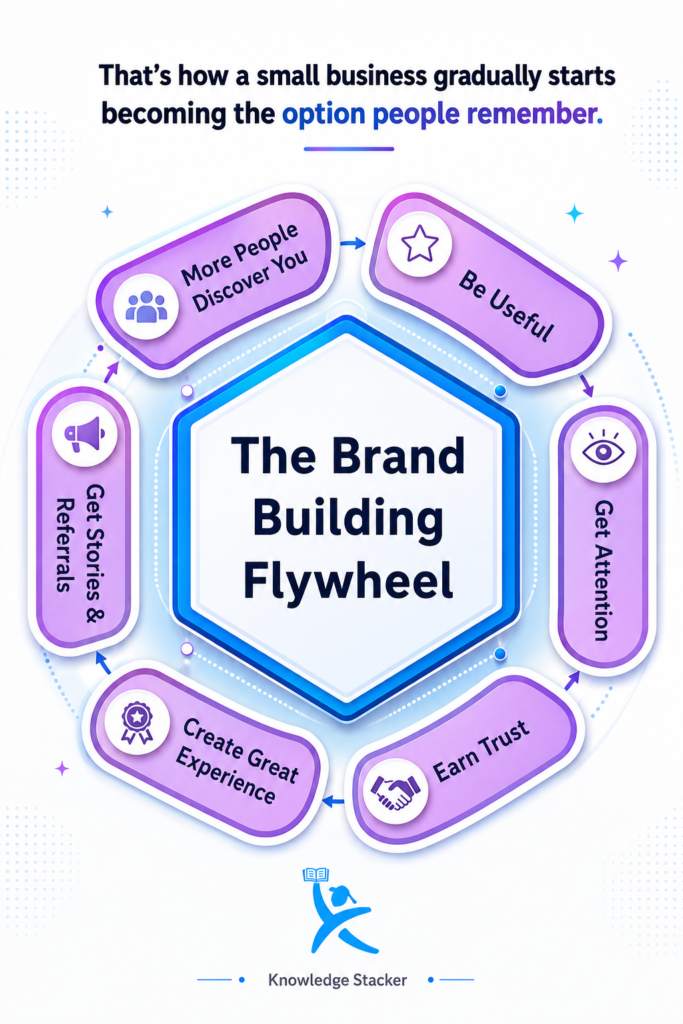
How to Build a Brand From Scratch: A Step-by-Step Guide
Step 1: Find the Brand You Already Have
Don’t invent your brand from scratch.
Investigate it.
Take your last 10–20 customers review or suggestion according to below questions and write down their solution :
- Why did they choose you?
- What problem were they trying to solve?
- What did they praise?
- What did they complain about?
- What did they ask before buying?
- What nearly stopped them from buying?
- What did they say after receiving the product or service?
- What do they usually call your product/service?
In this way, you can find something that your competitors cannot copy:
the language of customers. For example, imagine you run a small accounting business.
You might think that customers are coming because you are providing “professional accounting services.”
But your customers might say: “You explain everything without making me feel dumb.”
This is a very powerful statement. It contains the potential brand message:
Accounting made simple. All of a sudden, your content, website, sales talks, videos, and social media posts know what to do. Your first branding asset is not your logo. It is customer language.
Step 2: Find Your “Only We” Statement
It is an activity that many business people do not engage in.
Fill in this statement: “We are the kind of business that _____.”
Avoid answers such as “We provide high-quality products.”
Instead use answers such as “We are the kind of business that explains every repair before we start working on your car,” or “We are the bakery that remembers your order.”
The third example is significant because that creates an image of the company.
You may take it one step further and complete the statement: “We are the only ones to _____.”
Use “only” in a broader sense, because you are not creating a legal position, but defining your niche.
Instead of “We provide house cleaning services,” you may say something like “We allow busy parents to feel like they don’t have to work on weekends.”
The best possible response be something like “We are the home cleaning service that leaves the checklist for you.”
Step 3: Choose One Enemy
Great brands aren’t only remembered for what they offer.
They’re remembered for what they reject.
Your “enemy” doesn’t have to be a competitor.
It can be an old way of doing things.
For example:
- Confusing pricing
- Complicated jargon
- Slow customer service
- Cheap disposable products
- Pushy salespeople
- Generic experiences
- Hidden fees
- Endless paperwork
- Overcomplicated technology
Ask:
“What frustrates our customers about this industry?”
Then take a position against it.
If you’re a small web-design business, you might stand against:
“Websites nobody understands how to update.”
If you’re a fitness business:
“Fitness advice that makes normal people feel guilty.”
If you’re a financial service:
“Financial advice written for people who already understand finance.”
Your enemy gives your brand a point of view.
And points of view are considerably easier to remember than descriptions.
Step 4: Build a Brand Promise You Can Actually Keep
Your promise should be stated in a specific manner instead of being something impressive.
Here’s the way the formula works:
We help [particular customer] achieve [particular impact] without [thereby causing difficulties].
A simple example would include:
We help local eateries take professional pictures without studio expenses.
Just take a look at this.
The client knows immediately:
Who is the target group → What changes → Which difficulties can be avoided.
Step 5: Turn Your Promise Into a Brand System
Now comes the part most branding guides make unnecessarily complicated.
You don’t need 47 brand rules.
Start with five rules.
| Brand Rule | Example |
| We sound | Clear, confident, human |
| We never sound | Corporate, complicated, desperate |
| We talk about | Customer problems and outcomes |
| We avoid | Empty marketing phrases |
| We want customers to feel | “These people understand me.” |
This becomes your decision filter. Before publishing anything, ask:
“Does this sound like us?”
If the answer is no, don’t publish it just because a trend is performing well.
Step 6: Create a Recognizable Visual Signature
Build a Brand From Scratch that recognize Visual. Now and only now should you worry seriously about visuals.
Your visual identity should make recognition easier, not merely make your business “look professional.”
Choose:
1. One primary color
The color people most strongly associate with you.
2. One supporting palette
Two or three complementary colors are enough.
3. One typography system
Use a consistent heading and body font.
4. One image style
For example:
- Real customer environments
- Close-up product photography
- Bright natural lighting
- Hand-drawn illustrations
- Minimal studio images
5. One repeatable visual element
This is the secret weapon.
It could be:
- A distinctive border
- A recurring icon
- A particular photo composition
- A recognizable background
- A repeated illustration style
- A signature phrase
The objective isn’t:
“Does this look beautiful?”
The objective is:
“Would someone recognize this without seeing our name?”
Step 7: Create a “Brand Memory Loop”
How to Build a Brand From Scratch: The Brand Memory Loop Explained. Here is a different way to think about brand awareness.
People rarely remember a business because they saw it once.
They remember it because they encountered the same idea repeatedly in different situations.
Think of this loop:
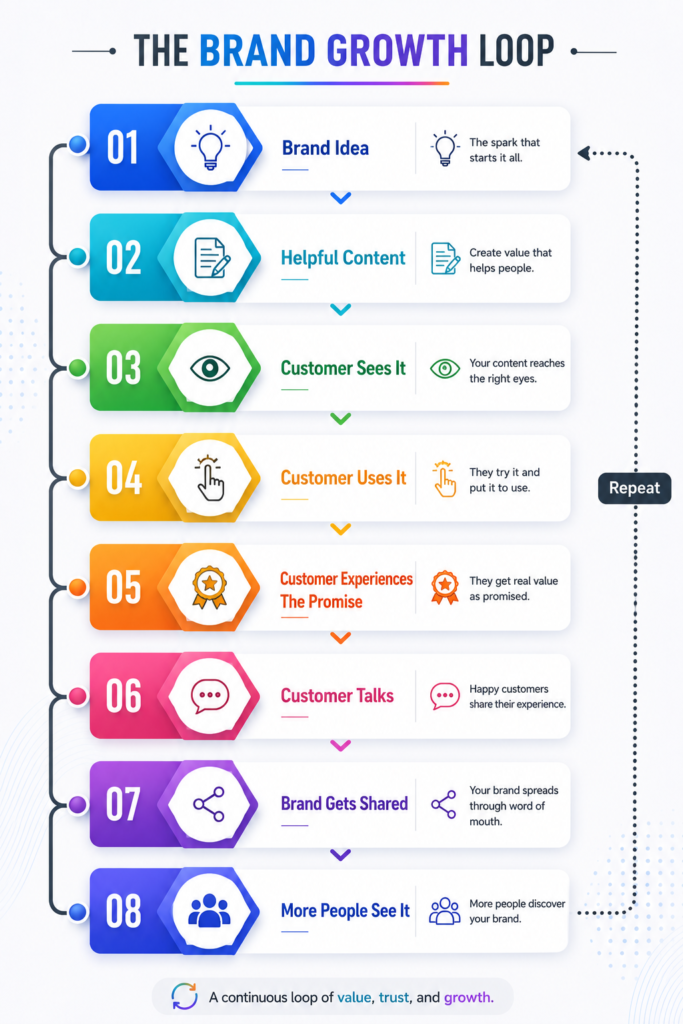
This is why consistency beats constant reinvention.
If Monday’s post says you’re the cheapest, Wednesday’s video says you’re premium, and Friday’s website says you’re convenient, you’ve created three brands.
Pick one memory.
Then repeat it until the market associates that memory with your name.
Step 8: Build Your “Content Moat”
Build a Brand From Scratch that show in content moat. Don’t create content simply because you need to post today.
Build content around questions your customers repeatedly ask.
Create five content buckets:
| Content Type | Purpose | Example |
| Teach | Demonstrate expertise | “3 mistakes costing you customers” |
| Prove | Build credibility | Before/after, case study |
| Reveal | Show your personality | Behind the scenes |
| Compare | Help decisions | “Cheap vs. expensive: what’s different?” |
| Story | Become memorable | Customer transformation |
A small business doesn’t need to publish 10 generic posts every day.
It needs to become the business people associate with a particular problem.
For example, don’t try to become:
“A local business that posts useful content.”
Become:
“The local business that makes confusing home repairs easy to understand.”
That’s a content moat.
Step 9: Use the 70/20/10 Brand-Awareness Rule
Build a Brand From Scratch Using the 70/20/10 Brand Awareness Rule.
For an early-stage business, your communication can roughly follow this structure:
70% — Be useful
- Answer questions
- Teach
- Explain
- Show people how to avoid mistakes.
20% — Prove it
Show:
- Customer results
- Testimonials
- Case studies
- Demonstrations
- Reviews
- Behind-the-scenes work
10% — Experiment
- Try trends.
- Test new formats.
- Make something unusual.
- The mistake is letting the 10% become your entire strategy.
- Virality can introduce someone to your business.
Consistency gives them a reason to stay.
Step 10: Turn Customers Into Your Marketing Department
Your first customers are more valuable than a thousand random followers.
Ask them for three things:
A sentence.
“What almost stopped you from buying?”
A story.
“What changed after you used us?”
A recommendation.
“What would you tell someone considering us?”
These answers can become:
- Website copy
- Social posts
- Testimonials
- Videos
- Case studies
- FAQs
- Advertisements
- Product improvements
Step 11: Build Your Brand Across Every Touchpoint
A brand breaks when the customer experiences five different personalities.
Imagine this:
Instagram: Friendly
Website: Corporate
Sales call: Pushy
Packaging: Cheap
Customer support: Robotic
The customer doesn’t experience “your brand.”
They experience confusion.
Create a simple touchpoint checklist:
| Touchpoint | What should remain consistent? |
| Website | Promise + personality |
| Social media | Voice + visual identity |
| Packaging | Visual signature |
| Sales | Customer-first language |
| Same personality | |
| Customer support | Brand behavior |
| Reviews | Experience should match promise |
Your brand is not built in the marketing department.
It is built everywhere the customer meets you.
Step 12: Measure Brand Awareness Without Fooling Yourself
Followers are useful.
But followers alone aren’t brand awareness.
Track four levels:
Level 1 — Visibility
- Reach
- Impressions
- Website visitors
- Video views
Level 2 — Recognition
- Branded searches
- Direct website visits
- Returning visitors
- Social profile visits
Level 3 — Trust
- Reviews
- Referrals
- Content saves
- Replies
- Repeat customers
Level 4 — Demand
- Enquiries
- Sales
- People says “I heard about you from…”
- Organic leads
The most interesting question you can ask customers is:
“Where did you first hear about us?”
Track the answers.
Over time, you’ll discover which channels are creating attention and which are creating actual memory.
The Final Rule: Don’t Try to Look Like a Big Brand
How to Build a Brand From Scratch: Don’t Try to Look Like a Big Brand This could be the most critical advice in the whole article.
A small company does not need to behave like a global corporation.
In reality, the smaller the company is, the more advantages it actually has.
You can do the following:
• Respond to customers in person.
• Tell true stories about your company.
• Introduce the people behind the company.
• Implement changes quickly.
• Keep in mind all of the customers.
• Support unpopular opinions.
• State the truth.
• Build relationships competitors cannot make.
Companies spend millions to look human. But you are human. Your goal is not to make everyone know you. Your main aim is:
When people face any issue you solve, you want them to remember your company first of all. This is how brand awareness starts when companies use your logo, they will get what they wanted to achieve with their brands.