
 By
By From a Small Dream to a Multi-Trillion-Dollar Technology Company
Today we all see NVIDIA success story, you may be curious about how a tiny startup with three founders turned into one of the biggest companies in the world. Nowadays, NVIDIA is gaining popularity. It drives artificial intelligence (AI), gaming, self-driving vehicles, robotics, cloud computing, and even medical researches and trials.
If you have heard of any AI programs like ChatGPT, programs for graphic creation, or advanced machine learning, it is likely that NVIDIA is responsible for that technology. But it is important to note that NVIDIA did not appear in the business abruptly. Refer NVIDIA site for more information https://www.nvidia.com/en-in/.
Years of competitiveness, bright ideas, and ambitions that had never occurred to anyone in the 1990s resulted in the success of this firm.
In this blog, you’ll discover:
- The history of NVIDIA
- The major decisions that changed the company’s future
- NVIDIA’s current business
- Financial performance and important ratios
- Future growth opportunities
The early years in the beginning, there was an idea.
The history of NVIDIA success story :
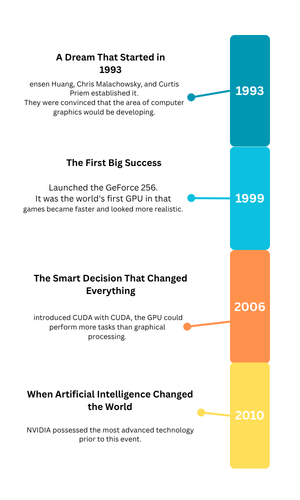
NVIDIA was established in 1993 by three engineers.
NVIDIA was founded in 1993 by three engineers:
- Jensen Huang
- Chris Malachowsky
- Curtis Priem
The year was 1993, and this was before rapid advancements occurred in the field of technology. Therefore, PCs back in those days were much more sluggish than they are today, video games had primitive graphics, and computers were typically used for trivial tasks.
The founders of NVIDIA believed otherwise. They believed that computer graphics would grow to be one of the most valuable technologies of the near future. Only a few believed in their vision. But this did not stop them from working tirelessly to produce more advanced graphics chips. And that is how NVIDIA came into existence.
The Early Difficulties
Success was not an easy achievement. In its initial years, NVIDIA met a lot of financial difficulties along with fierce competition.
The resources of the company were limited and it had to fight against much larger players. At one time, NVIDIA was on the verge of running out of cash. However, rather than giving up, the company kept on improving its technology.
This persistence helped the company go through one of the hardest times in its life.
The Product That Changed the Game
From 1999, everything changed.
NVIDIA introduced its GeForce 256, widely regarded as the first ever Graphics Processing Unit (GPU). Previously, graphics were done mainly through the CPU. The introduction of the GeForce GPU proved revolutionary because it allowed for faster graphics processing.
Gamers loved the product because it brought about:
- A faster gaming experience
- Smoother gameplay
- More realistic graphics
- More absorbing visuals
The introduction of this product catapulted NVIDIA into the leading gaming company and innovator in the sector.
The Intelligent Strategy that created NVIDIA’s Future
Other businesses could have been satisfied with concentrating on games alone.
However, NVIDIA had bigger plans. In 2006, it launched CUDA.
CUDA opened a pathway for developers to tap into NVIDIA GPUs for purposes other than gaming.
All researchers that were using GPUs for things such as:
- Machine learning
- Medicine
- Engineering simulations
- Meteorology
- Computing
- Analytics
This decision helped create a whole software ecosystem based on NVIDIA hardware.
Today, CUDA is one of NVIDIA’s biggest assets with millions of developers utilizing it.
What is NVIDIA Today’s Role?
There are still people who think that NVIDIA is only about graphics card manufacturing.
It used to be true a long time ago. At present, however, NVIDIA has turned from being merely a gaming establishment. Currently, AI is the most important line of NVIDIA’s business.
NVIDIA Graphics Processing Units (GPUs) power the following items:
- Large Language Models (LLM)
- Chatbots
- Video creation
- Research in Science
- Robots
- AI in Medicine
- Many leading players in the AI market continue to use NVIDIA technology.
Data Centers :
This is the most rapidly growing branch of NVIDIA’s business.
Cloud companies buy numerous NVIDIA AI chips to provide their cloud computing and AI services.
Data centers currently account for the bulk of NVIDIA’s sales.
Gaming :
Gaming is a key sector for NVIDIA.
Millions of gamers use GeForce graphics cards due to their high performance and wonderful graphics.
Automotive :
NVIDIA makes AI systems for self-driving and smart vehicles.
Numerous car manufacturers apply NVIDIA’s technology to make their vehicles safer and more intelligent.
Robotics :
Factories, warehouses, and industries use NVIDIA-powered robots to automate complex tasks.
Financial Results that shows NVIDIA Success Story
In the last few years, NVIDIA’s financial performance has been exceptional.
The demand for AI chips has accelerated significantly, resulting in unprecedented income and profits.
Notably, some of the notable drivers behind this growth are:
- Huge demand for AI hardware
- Best technology in the industry
- High profit margins
- Persistent innovation
- Long-term investments into R&D
Moreover, the company boasts solid cash flows, enabling it to invest in technologies of the future and reward the shareholders simultaneously.
NVIDIA’s Financial Performance (Jully 2026)
| Financial Metric | Current Value | What It Tells Us |
| Revenue | $215.9 Billion | Strong global demand for NVIDIA products |
| Net Profit | $120.1 Billion | Exceptional profitability |
| Market Capitalization | Around $4.8–$5.0 Trillion | Investors expect strong future growth |
| Gross Profit Margin | 71.1% | High profit on every product sold |
| Operating Income | About $125 Billion | Very profitable core business |
| Cash Available | More Than $50 Billion | Strong financial stability |
| Employees | Around 42,000 | A global workforce driving innovation |
Comprehending NVIDIA’s Financial Ratios
Financial ratios are crucial for investors in finding out the actual strength of the company.
1. Gross Profit Margin
Approximate figure: 75%
What does it show?
Gross Profit Margin shows how much profit NVIDIA is maintaining after production costs.
What does 75% mean?
It means that NVIDIA earns approximately $75 compared to every $100 in sales.
It indicates that the company features high-grade product and has solid pricing capacity.
Rating: Excellent
2. Net Profit Margin
Approximate Value: 55%
What does it show?
Net Profit Margin measures how much profit remains after all business expenses, taxes, and operating costs.
What does 55% mean?
For every $100 NVIDIA earns, about $55 becomes profit.
This is exceptionally high for a company of its size.
Rating: Outstanding
3. Return on Equity (ROE)
Approximate Value: 110%–120%
What does it show?
ROE measures how effectively NVIDIA uses shareholders’ investments to generate profit.
What does it mean?
For every $100 invested by shareholders, NVIDIA generates more than $110 in annual profit.
This reflects very strong financial performance, although accounting factors and share buybacks can also affect ROE.
Rating: Exceptional
4. Return on Assets (ROA)
Approximate Value: 60%
What does it show?
ROA measures how efficiently the company uses its assets to generate profit.
What does it mean?
For every $100 invested in assets, NVIDIA earns approximately $60 in profit.
This indicates outstanding operational efficiency.
Rating: Excellent
5. Current Ratio
Approximate Value: 4.4
What does it show?
The Current Ratio measures whether NVIDIA can pay its short-term liabilities using its short-term assets.
What does 4.4 mean?
For every $1 of short-term debt, NVIDIA has about $4.40 in current assets.
This indicates excellent financial stability.
Rating: Very Strong
6. Debt-to-Equity Ratio
Approximate Value: 0.12
What does it show?
This ratio compares the company’s debt with shareholders’ equity.
What does 0.12 mean?
For every $100 invested by shareholders, NVIDIA has only about $12 in debt.
This means the company relies very little on borrowing.
Rating: Excellent
7. Price-to-Earnings (P/E) Ratio
Approximate Value: 55–65 (changes with the stock price)
What does it show?
The P/E ratio compares NVIDIA’s stock price with its earnings per share.
What does a P/E of 60 mean?
Investors are willing to pay about $60 for every $1 of NVIDIA’s annual earnings because they expect the company to continue growing rapidly.
A high P/E often reflects confidence in future growth, but it also means the stock may be more sensitive if growth slows.
Rating: Premium Growth Stock
What distinguishes NVIDIA from the rest?
The main strength of NVIDIA is not only its hardware.
NVIDIA has established a fully operational ecosystem consisting of:
Graphics processors
CUDA
Artificial intelligence frameworks
Development tools
Cloud computing
Network
When developers create applications based on NVIDIA’s platform, this becomes a reason for clients to keep utilizing NVIDIA’s products.
Challenges NVIDIA May Face
No company, no matter how big, is immune to facing challenges.
The main threats faced by NVIDIA include the following:
Mounting competition coming from other manufacturers of chips.
Sky high expectations from its stockholders.
Restrictions in exports from some foreign markets.
Reliance on partners who manufacture advanced chips.
Fast development of technologies related to artificial intelligence.
Although it has to address all these issues, NVIDIA keeps on investing significant amounts of money into innovations to remain at the top.
Here are some remarkable facts about NVIDIA:
NVIDIA was formed by three engineers. In the beginning, NVIDIA had come close to dropping out. Jensen Huang has maintained his position as CEO since then.
NVIDIA invests multiple billions of dollars for R&D on a yearly basis. Its GPUs have been employed in artificial intelligence, healthcare, and gaming. NVIDIA has also been considered one of the most valuable tech companies across the globe.
CUDA has become one of the best-known platforms for artificial intelligence and high-performance computing.
What Can We Learn from NVIDIA?
NVIDIA’s journey offers valuable lessons for entrepreneurs, students, and investors.
- Believe in your long-term vision.
- Invest in innovation, even when results take time.
- Build products that solve real problems.
- Create an ecosystem that keeps customers engaged.
- Stay adaptable as technology changes.
- Never stop learning and improving.
These principles helped NVIDIA grow from a small startup into a global leader.