
 By
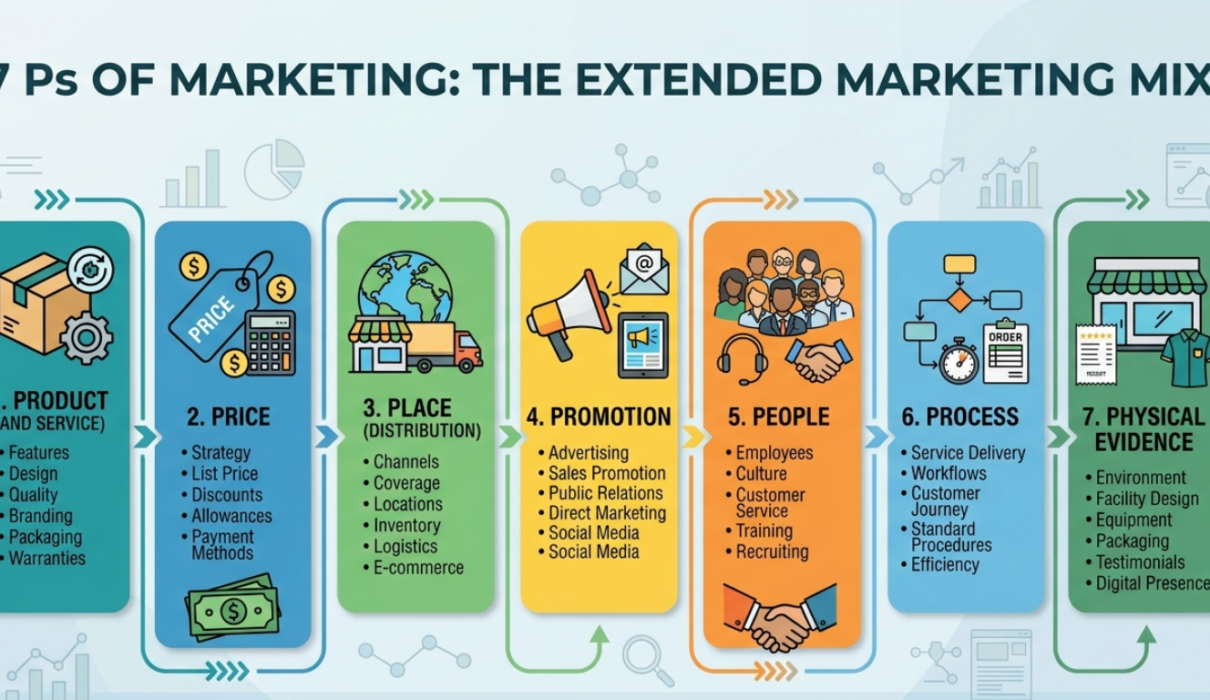
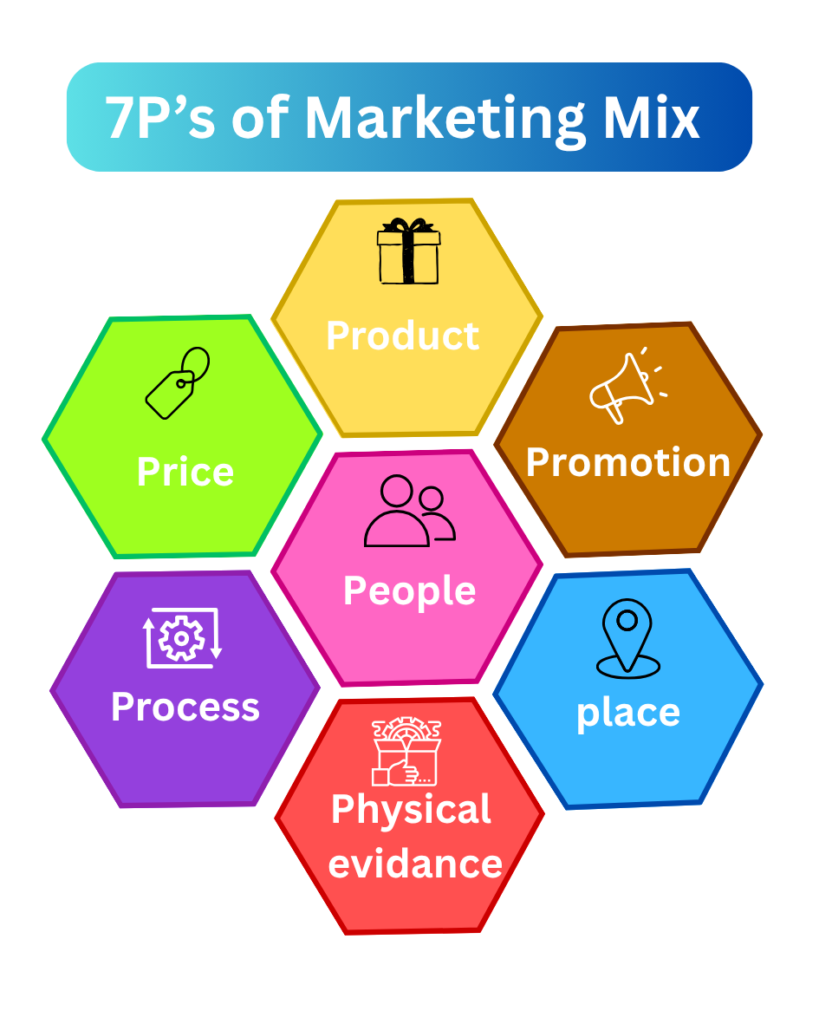
By Marketing is marketing is essential for business. It helps business grow more. The 7 Ps of marketing are primary things of any business that are Product, Price, Place, Promotion, People, Process, and Physical Evidence.
7 Ps are very important in the marketing mix. Here we include all the aspects of marketing. 7 P is the upgraded version of 4 P. At 4 Ps, we primarily focus on core P’s, which are product, price, place, promotion. In this, all Ps are related to the product, meaning that price, place, and promotion are product centric and don’t focus on consumers. Making a product according to our perception, setting a price according to that, placing and promotion handling directly they don’t take a customer perspective.
But in the current scenario, people are the most important in the marketing mix, and that is why, in 7 Ps of marketing that includes in the previous 4 Ps, we don’t have people. That is why new 7 Ps are advanced and more reliable than the older 4 Ps. Today, most people use 7 Ps of marketing mix. They focus on customer relationships. Today, companies can take customer review and focus on value-giving products.
1. Product
A product is anything that someone can provide to meet a need.
The product can be a physical product, a service, or an experience. To create a successful product, it must solve a problem or fulfill a need better than the competition.
Key Factors:
Concentrate on quality, features, design, and branding.
Differentiate your product so customers can find it.
Continuously improve your products using feedback from customers.
Know the four stages of the product life cycle (introduction, growth, maturity, and decline).
2. Price
The price is the amount that the customers pay for your product. The price that you set influences how much you will sell and how much profit you will make. Price will also influence whether customers see you as a cheap, low-quality brand versus a premium, high-quality brand.
Pricing Strategies:
Cost-Based Pricing: Profit Margin is added to the cost.
Value-Based Pricing: Pricing is based on how customers see the value of the product.
Competitive Pricing: Pricing is set according to the price that your competitors charge for the same product.
Strategies to Influence buying behavior: Psychological pricing (i.e. pricing at ₹999 vs. ₹1000) and discounts.
3. Place
Place refers to how your product gets to the customer. This means considering the distribution channel or the way you deliver the product, to how accessible the product is to the customer.
Key Factors:
Your choice of selling directly (through your own website/store), or through intermediaries (retailers and wholesalers).
How much of a market coverage you want to reach (i.e. broad, selective or exclusive).
Be efficient in your logistics (moving the product to the customer) and delivery, and managing your inventory.
The ultimate goal of place is to have your product available to the customer at the right time, in the right place.
4. Promotion
Promotion is all of the activities that are used to communicate and persuade customers to purchase a product.
Main Tools Used:
1. Advertising
2. Direct Marketing
3. Promotional Sales
4. Public Relations Provide Out of Order (Brand & Attract)
5. People
People cover everyone who works in company to making product, to deliver the product and also in services offers by company. Such as employees, sales people, and customers.
Why it is important?
Quality customer service will foster trust and loyalty.
Trained employees make the customer’s experience better.
Happy employees increase their productivity.
Customer interaction directly impacts your brand reputation.
6. Process
Process means all activities that deliver your product or service to the customer. Process means procedures and systems used to deliver your product or service.
Important aspects:
Work efficiently and effectively
Make customer journey smooth (simple ordering, quick delivery, easy returns)
Apply technology
Monitor and improve processes constantly
Effective process increases customer satisfaction and decreases expenses.
7. Physical Evidence
Physical evidence means how you fill about product or service. It includes various aspects like packaging, branding, and the environment in which the service is delivered. Physical evidence serves as a concrete confirmation of the quality of your product or service.
Key Factors:
Package design and branding
Store design or website design
Customer feedback
Certifications, awards, guarantees
These factors increase brand credibility, especially when it comes to purchasing services.
When to Apply the 7 Ps Framework
There are numerous occasions when the 7Ps model can be applied:
Formulating marketing strategies or improving them
Creating new products or services
Expanding into new markets
Analyzing competitors
Improving customer experience
Marketing research
Importance of the 7Ps
Give a comprehensive insight into your marketing strategy
Maintain focus on the customer
Generate competitive advantage
Ensure consistency of all marketing efforts
Facilitate making decisions based on sound planning
Examples of Companies for Each of the 7 Ps of Marketing
1. Product
• iPhone – Highly designed; superior camera; product ecosystem
• Maggi Noodles – Quickly made, delicious and convenient
2. Price
• Zara – Moderately priced fashionable wear
• Rolex – Highly priced watches as luxury products
3. Place
• Amazon – Shopped online with global delivery services
• Reliance Retail – In physical stores within India
4. Promotion
• Coca-Cola – Emotive advertising; festival participation; celebrity promotions
• Nike – Influencer promotions; ‘Just Do It’ marketing strategy
5. People
• Taj Hotels – Superb customer interaction by employees
• Indigo Airlines – Courteous cabin crew
6. Process
• McDonalds – Consistent services worldwide in all restaurants
• Amazon – Ordering process, delivery time and returns policy
7. Physical Evidence
• Starbucks – Store ambience, unique cup design
• Apple – Unique store layouts, premium packaging