
 By
By Introduction
Today every business, regardless of size and significance, the same fundamental question faces all organizations: where are we now, and where do we want to go? SWOT analysis is one of the most ancient strategic tools for answering this question. It is easy to draw on paper yet has the potential to become an essential component of a company’s entire strategy.
In this article, you will get to know what exactly SWOT analysis is, why it is relevant even in 2026, how to carry it out step by step, and how it contrasts with other strategy tools, i.e. PESTLE and Porter’s Five Forces. It also provides you with a filled out SWOT analysis template as well as a case study of FedEx and industry specific examples.
Porter’s Five Forces provides a deeper view of competitive pressure within an industry, including rivalry, new entrants, substitutes, buyers, and suppliers.
Harvard Business School’s Five Forces framework https://www.isc.hbs.edu/strategy/business-strategy/Pages/the-five-forces.aspx
What Is SWOT Analysis?
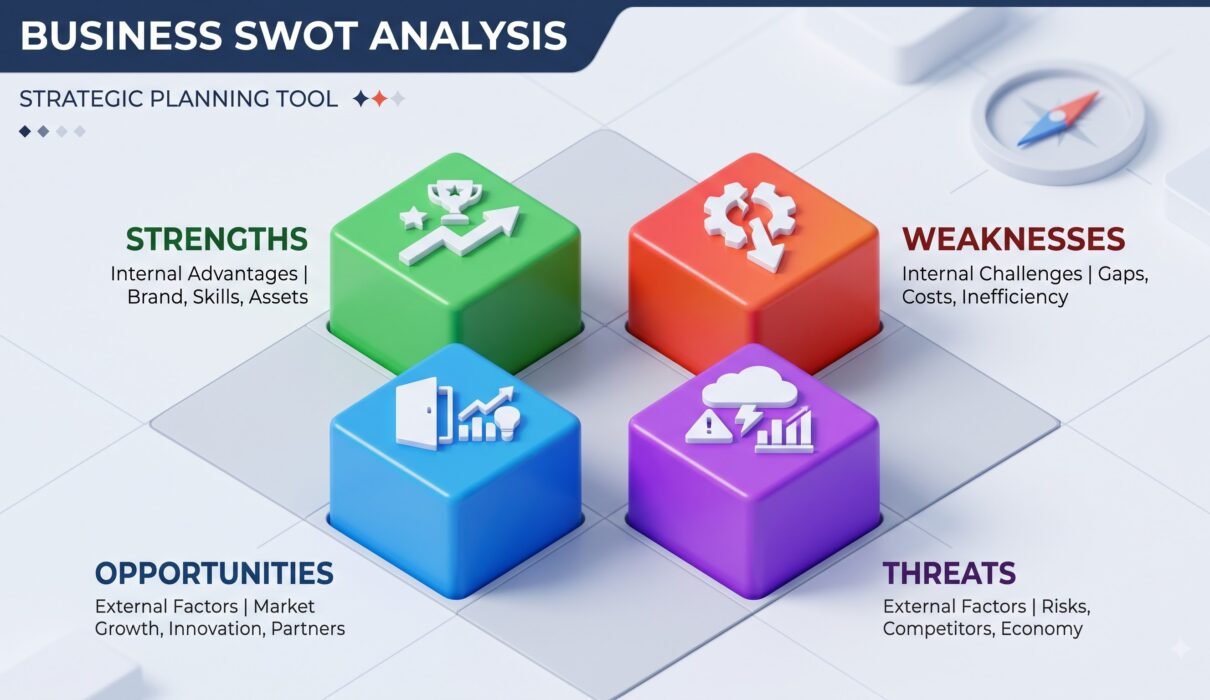
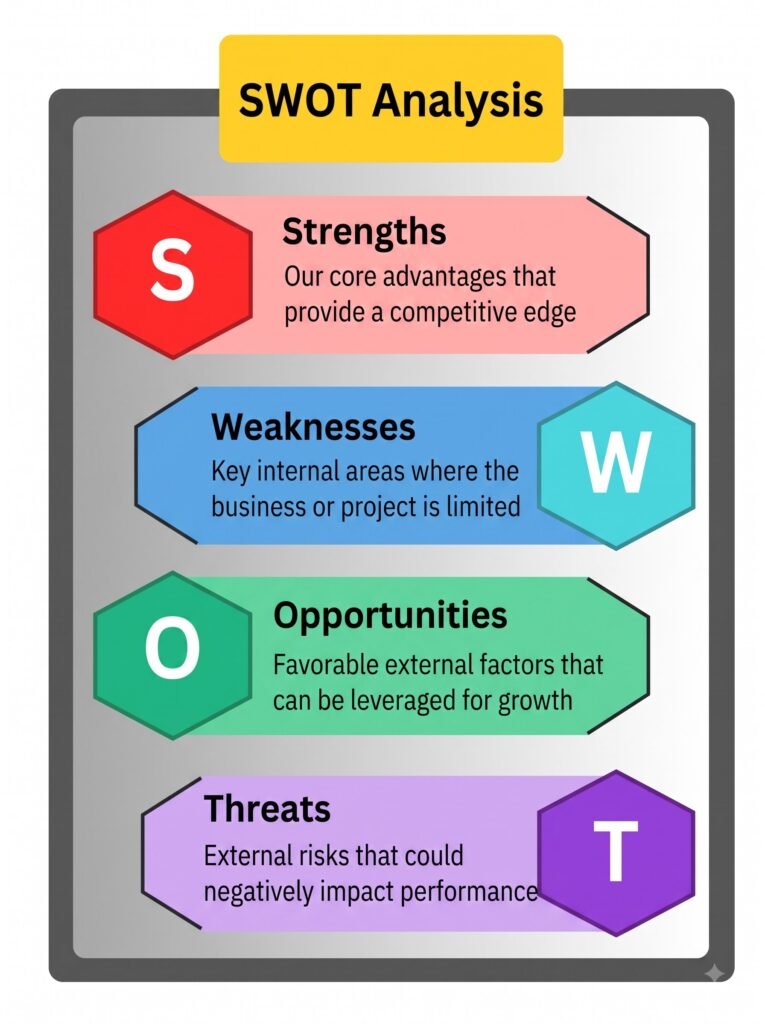
The SWOT Analysis is a planning framework which helps assess an organization’s Strengths, Weaknesses, Opportunities, and Threats. According to this framework, strengths and weaknesses are internal aspects of the organization, such as its staff, processes, and financial state. Opportunities and threats are related to the external aspects of the organization, such as market trends, competitors, regulations, and the economy.
The SWOT analysis technique was introduced in the 1960s at Stanford Research Institute. It has been successfully utilized as a widely used tool in the world business practices in business schools, marketing plans and meetings of boards.
The popularity of SWOT analysis is determined by one main reason: it requires systematic, clear reasoning and no special software or training.
Why SWOT Analysis Is Important
- Clarity before action: It stops teams from jumping straight to solutions before understanding the full picture.
- Balances internal and external thinking: Many teams over-focus on internal capability and ignore market shifts, or vice versa.
- Supports multiple use cases: Used for business strategy, product launches, marketing campaigns, personal career planning, competitor analysis, and even nonprofit program evaluation.
- Cheap and fast: No special tools required just structured facilitation.
- Foundation for other frameworks: Many strategic plans use SWOT as the first step before deeper tools like TOWS, PESTLE, or OKRs.
The Four SWOT Components
Strengths (Internal, Positive)
Internal capabilities that put the organization at an advantage. Ask: What do we outperform competitors in? What do we possess that others do not? What are we famous for in the eyes of our customers? Examples: well-known brand, exclusive techniques, competent personnel, opportunity to conduct operations at a low cost, and loyal clientele.
Weaknesses (Internal, Negative)
Internal weaknesses putting the organization at a disadvantage. Ask: What are the mistakes we commit while competing? What do the clients think we are incapable of? What does our resource list lack? Examples: obsolete equipment, high staff turnover, weak online visibility, limited financial experiences, and inconsistency of quality control.
Opportunities (External, Positive)
External trends and conditions exploiting which the organization would prosper. Ask: What trends are favourable for us? What niches exist in the market? What partners and technologies are at our disposal? Examples: expanding markets, technology implementation, legislative changes in favour of the industry, and changing consumer preferences.
Threats (External, Negative)
External factors negatively influencing the organization. Ask: Where do the competitors win? What are the legislative or economic risks we might be facing? What developments could ruin our market? Examples: new companies entering the market, increasing prices for resources, legislation changes, recession, and leading-edge technologies.
The SWOT Matrix
The classic way to visualize a SWOT Analysis is a 2×2 grid:
| Helpful (to achieving objective) | Harmful (to achieving objective) | |
| Internal (Organization) | Strengths: strong brand skilled team proprietary tech | Weaknesses: limited budget outdated systems high turnover |
| External (Environment) | Opportunities: new markets favourable regulation emerging tech | Threats: new competitors rising costs economic downturn |
SWOT Analysis Template (Fillable)
Copy this structure into a document, spreadsheet, or whiteboard tool:
SWOT Analysis Worksheet (Guided Version)
Use these prompts during a workshop or self-assessment session:
Strengths
- What do we do better than anyone else?
- What unique resources can we draw on?
- What do customers/clients consistently praise?
Weaknesses
- What could we improve?
- What do we lack (resources, skills, reputation)?
- What are competitors doing better than us?
Opportunities
- What trends could we take advantage of?
- Are there gaps our competitors are missing?
- What changes (technology, regulation, demographics) work in our favor?
Threats
- What obstacles do we currently face?
- What are competitors doing that could hurt us?
- Could any of our weaknesses expose us to serious risk?
Step-by-Step Guide to Conducting a SWOT Analysis
1. Identify the goal: A SWOT analysis of “Should we launch this product?” will be very different from one that examines the question “Should we enter this market?” Be clear and precise.
2. Assemble the right people: Ensure that you have the right mix of participants. Include experts from different departments such as sales, operations, finance, customer service, and not just senior management.
3. Collect data first: Gather customer responses, sales statistics, information on competitors and business reports prior to the meeting instead of relying solely on opinions.
4. Work out various quadrants one by one: You have to set a time limit (e.g. 10-15 minutes) for each quadrant to be worked out properly.
5. Rank the points: Not all points carry the same weight.
6. Conduct cross-analysis (TOWS step): You should pair strengths with opportunities, weaknesses with threats, and vice versa.
7. Translate the ideas into reality: Define the people in charge and set deadlines for tasks based on top 3-5 priorities.
8. Repeat the procedure from time to time: SWOT will not help if done once and shelved; conduct SWOT every quarter or during important changes in business strategy.
Advantages and Disadvantages of SWOT Analysis
| Advantages | Disadvantages |
| Simple, requires no special tools or training | Can produce vague, generic lists without rigor |
| Encourages structured thinking | Doesn’t rank or weight factors by importance on its own |
| Works for any industry, team size, or project | Static snapshot can go stale quickly |
| Combines internal and external perspective | Risk of bias if only leadership contributes |
| Fast and low-cost to run | Doesn’t provide solutions by itself needs a follow-up strategy step |
Common Mistakes to Avoid :
- Being too vague. “Good team” is not useful; “low turnover and deep technical expertise in cloud infrastructure” is.
- Confusing internal and external factors. A weakness is something you control; a threat is not.
- Only involving leadership. Frontline staff often see weaknesses and opportunities leadership misses.
- Treating it as a one-time exercise. Markets shift SWOT should be revisited periodically.
- Skipping the “so what.” A list of 20 bullet points with no prioritization or action plan wastes the exercise.
- Ignoring data. Relying purely on opinion instead of grounding the analysis in real customer, sales, or market data.
SWOT vs. PESTLE vs. Porter’s Five Forces vs. SOAR vs. BCG Matrix :
| Framework | Focus | Best Used For |
| SWOT | Internal + external factors (4 categories) | General strategic snapshot, quick planning sessions |
| PESTLE | Political, Economic, Social, Technological, Legal, Environmental (external only) | Deep external/macro-environment analysis |
| Porter’s Five Forces | Competitive intensity within an industry | Understanding industry attractiveness and competitive pressure |
| SOAR | Strengths, Opportunities, Aspirations, Results | Positive, appreciative-inquiry style planning |
| BCG Matrix | Market growth vs. market share of products | Portfolio and product-line investment decisions |
How they fit together: Many strategists run PESTLE first to understand the macro-environment, feed relevant findings into the “Opportunities” and “Threats” of a SWOT, then use Porter’s Five Forces to sharpen competitive threats, and finally use the BCG Matrix if the decision involves a multi-product portfolio.
Complete Case Study: FedEx SWOT Analysis
Background: FedEx is one of the world’s largest logistics and delivery companies, operating across air, ground, and freight transportation with an extensive global network. https://www.fedex.com/en-in/home.html
Strengths
• Established international logistics system characterized by efficiency and reliable delivery
• Established company’s image associated with express delivery
• Diversity of services (Express, Ground, Freight, Logistics)
• Accurate tracking and technology monitoring of shipment
• Massive fleet of vehicles
Weaknesses
• High fixed operating costs related to fleet, fuel and workforce
• Complex organizational structure including many business sectors
• Prone to fluctuations of fuel prices
• Dependence on the state of the world trade and e-commerce volumes
Opportunities
• Growth of e-commerce and demand for last-mile delivery
• Expansion into new emerging markets with opportunities for manufacturing and trade
• Investments in automation, electric vehicles and logistics of sustainable type
• Expansion of same-day delivery and on-demand delivery services.
Threats
• High competition from UPS, DHL, Amazon Logistics and local carriers.
• Risarising costs for fuel and labor.
• Decrease of shipping volume due to financial crises.
• Changes in regulations and tariffs affecting international shipping.
Summary
FedEx’s biggest asset its international delivery system could also be regarded as one of its greatest liabilities because of high fixed costs. That said, investing in efficiency in terms of automation becomes vital in order to remain profitable.
Actionable Strategic Recommendations (TOWS Cross-Analysis)
Once your four lists are built, cross-analyze them to generate real strategies:
- SO (Strength + Opportunity): Use strengths to capture opportunities. E.g., use strong brand trust to enter a new market segment.
- WO (Weakness + Opportunity): Fix weaknesses by leveraging opportunities. E.g., use new automation technology to offset an operational weakness.
- ST (Strength + Threat): Use strengths to defend against threats. E.g., use financial reserves to weather an economic downturn competitors can’t survive.
- WT (Weakness + Threat): Minimize weaknesses to avoid worst-case threats. E.g., reduce dependence on a single supplier to avoid disruption risk.
This TOWS step is what turns a SWOT list into an actual strategic plan.
AI’s Role in Improving SWOT Analysis
AI-based systems can greatly improve the existing SWOT technique:
• Speed of information collection: AI offers the possibility of extracting useful insights from such sources as customer feedback, competitors’ websites, and industry reports and filling SWOT quadrants with real data rather than assumptions.
• Minimization of biases: AI has the capability of identifying limitations of one team’s assessment by contrasting data from various sources.
• Identification of patterns: AI software can detect frequent occurrences in various commentaries and documents long before a human can do it.
• Scenario analysis: AI can also test various options a strategist may choose, according to the TOWS technique.
• Continuous updates: A SWOT based on AI can be regularly updated with new information rather than being a one-time project.
Best Practices for SWOT Analysis
- Ground every point in evidence, not assumption
- Keep each bullet specific and measurable where possible
- Involve diverse stakeholders, not just leadership
- Limit each quadrant to your top 5–7 most impactful points
- Always follow up with a TOWS cross-analysis and action plan
- Revisit the SWOT on a regular cadence (quarterly or at major inflection points)
- Assign clear owners to resulting action items