

 By
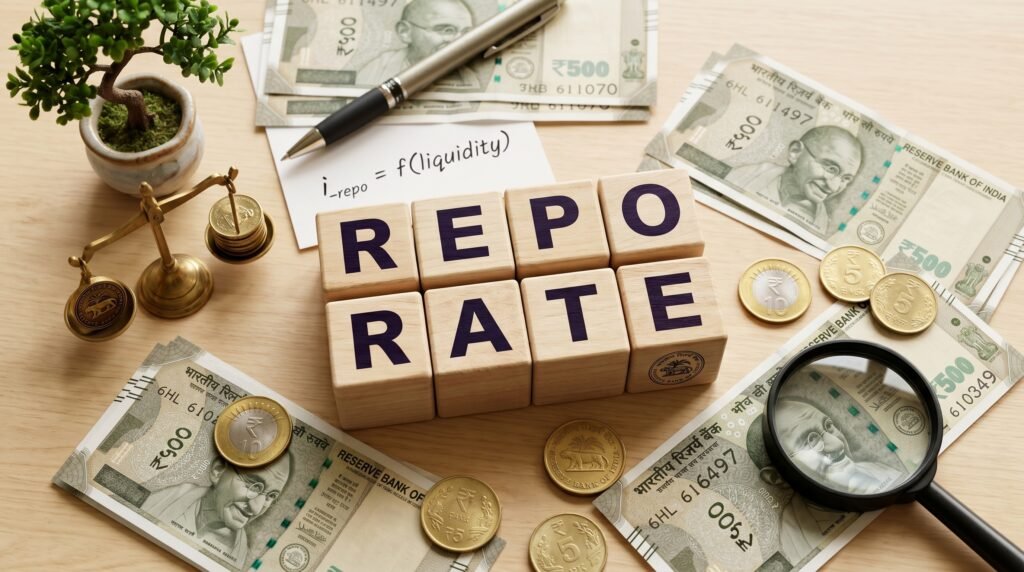
By The repo rate is also known as “repurchase Agreement” the repo rate in the primary tool or instrument for reserve bank of India Which implements in monetary policy .the repo rate is the interest rate at which central bank lends money to the commercial bank for short term requirement such as seasonal fluctuations in demand, sudden surges in credit disbursement, or regulatory requirements typically using government securities as a collateral.in simple words the commercial banks borrows money from reserve bank of India for short term liquidity shortages. bank borrows by pledeging government securities as a collateral , with a formal agreement to repurchase them at a future date at a predetermined, higher price.
Mechanism of repo rate and How Does the Repo Rate Work :
the repo rate is instrument of RBI the RBI manage liquidity with the help of Repo Rate the rbi utilise this tool for microeconomics objective primary inflation control and economic stability. When a commercial bank faces a cash crunch, it approaches the central bank and pledges approved government securities as collateral. The central bank provides the required funds at the prevailing repo rate. After a specified short-term period (often overnight), the borrowing bank repurchases its securities by returning the principal loan amount plus the interest calculated at the repo rate. This interest serves as the bank’s cost of borrowing, which fundamentally dictates the interest rates the bank will charge its own customers for loans.
Impact of repo rate on consumer :
the change in repo rate gives advantage and disadvantage to the consumer.
1.when the repo rate increases
the commercial bank and non-banking financial company (NBFC) increase their lending rates, resulting higher equity monthly instalment (EMI) borrowing become expensive. then consumer get loan at higher rate of interest from banks and NBFC the consumer does not afford higher interest loan and thus they reduce their non-essential spending however some customer get benefit from this which save money and deposit in the bank as Bank offer higher return on fixed deposit this customer gets higher interest rates.
2. when the repo rate decreases
When the repo rate decreases the bank and NBFC gives low interest rates. some customer get benefit on loan and EMI and the take more Loan at low interest. Not only invest money but also spends this money. But some customer which saves the money in bank FD it gives low interest rates.
Impact of repo rate on business :
1. when repo rate increases
the interest rate are increases and loan amount also increases for the businesses. Due to this a company Delay or stop their new projects as well as pause hiring jobs. This reduces the growth of companies and affect profitability.
2. when repo rate decreases
The rate of interest also decreases due to these businesses due to these businesses take loan at cheap rate of interest from bank and invest in their businesses. due to this business has grow fast and company earn more profit.
How repo rate impact on Indian economy :
the repo rate act as primary accelerator and brake for Indian economy
when RBI increase the repo rate to control inflation by reducing money supply conversely, when rbi decreases the repo rate the money supply is injected that stimulates economic growth.
RBI used repo rate to control the Rupee value. Higher the repo rate attracts foreign investors which increases demand of Indian rupee. when the repo rate is lower than it reduces value of Rupee.
repo rate also impacts on financial market when repo rate cut then lower the cost of capital required which boost the equity market and bond market. conversely, higher rate can depress stock market as well as bond market.
Example, at the time of COVID-19 pandemic rbi reduce the report around 4% after the pandemic over the rbi aggressive hiked the repo rate 6.5%.
Who handle the repo rate :
In India, the monetary policy committee (MPC) of The Reserve Bank of India (RBI) responsible for setting the repo rate headed by RBI Governor. there at 6-member three member are selected by RBI and three members are selected by central government. the committee is tasked which setting the policy rate required to achieve the inflation target which is currently set at 4% with tolerance and of +/- 2%. This target is Defined by government of India in consultation of with rbi.
this is 6-member panel and rbi Governor conduct meeting every 2 months. in this meeting the committee reviews key micro economic indicators such as retail inflation, GDP growth tragedy and global liquidly conditions.
What happen when we do not use repo rate/alternate options
The RBI uses the Repo Rate as a primary tool to provide price signals and manage the flow of money into or out of the economy since the Repo Rate is used by the RBI to control the liquidity of the country. If the Repo Rate doesn’t get used by the RBI or Banks, there are various alternate tools used by RBI to control the liquidity outflow from the economy.
1. Reverse Repo Rate (RBI borrows from banks) :
provides an incentive to banks to Park the excess cash into the central bank to ensure security instead of lending the cash to the public & seeing how accessible to the economy the money would be lent out into the economy.
2. Standing Deposit Facility (SDF) :
then the SDF is used when the RBI absorbs the excess cash from the banking system and does not require the banks to hold onto the securities from the government as collateral for any government loans to banks.
3. Marginal Standing Facility (MSF):
is used by banks when the banks in India are experiencing an emergency need for borrowing cash from the RBI and wish to borrow cash from the RBI above the Repo Rate of the day.
4. Open Market Operations (OMO) :
the central bank of India (RBI) is able to adjust the monetary supply directly by purchasing and selling government short term (Treasury Bills) in the open market. or selling short-term government debt (like Treasury bills) in the open market.
5. Asset Purchase Programmes / Quantitative Easing:
the central banks take advantage of this program or method to help their economy by purchasing large amounts of financial instruments in distressed economies in order to introduce money supply into an economy. Typically, through an increase in the money supply is usually accomplished through an asset purchase program (quantitative easing).
6.Bank Rate:
historically, the bank rate was the main policy rate of a bank; now it is used only as a penal rate for banks in violation of their CRR/SLR requirements or for banks that do not meet their reserve requirements with the central bank. Unlike repo loans, banks are not required to pledge securities in order to borrow at the bank rate.