
 By
PESTEL analysis is a checklist for scanning the outside forces means the external forces that can help or hurt a business: Political, Economic, Social, Technological, Environmental, and Legal. You list what is happening in each area, rate how much it matters, and decide what to do about it. This guide walks through all six using Tesla as a real, current example, then gives you a template to run your own.
Most business plans are written from the inside out our product, our team, our costs. But a lot of what decides whether a company wins is outside its control, such as a subsidy ending, a tariff, a new safety rule, or a shift in what customers believe.
PESTEL is a simple way to look at those outside forces on purpose instead of by accident. This post explains the framework, shows it applied to Tesla using sources dated through mid-2026, and gives you a scorecard format you can reuse for any company or idea.
In this guide
- What is PESTEL and when to use it
- How to run one, in five steps
- Worked example of Tesla
- The Tesla PESTEL scorecard
- What the analysis tells us
- A PESTEL template to copy
- Common mistakes
- Key takeaways and FAQ
What is PESTEL and when to use it :
PESTEL (sometimes written PEST or PESTLE) is a macro-environment scan. It looks at forces that affect every company or organization in an industry. PESTEL is wider and external concept that makes it different from SWOT, which mixes outside forces (opportunities and threats) with inside ones (strengths and weaknesses). A common approach is to run PESTEL first, then feed the results into the opportunities and threats boxes of a SWOT.
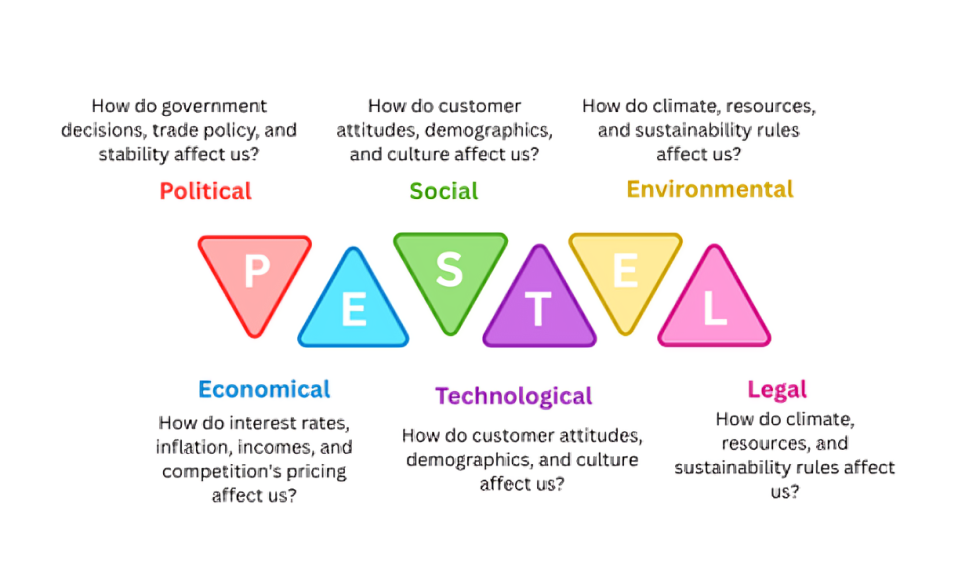
Use PESTEL when you a reentering a new market or country, writing a business plan, assessing an industry before investing, or reviewing strategy once a year. Skip it when you need a view of your own strengths and weaknesses. How SWOT works see in detail and learn how to evaluate a business’s strengths, weaknesses, opportunities, and threats to make better strategic decisions.https://knowledgestacker.com/swot-analysis-complete-guide-with-examples/
How to run a PESTEL in five steps
- Define the scope. Pick one company, one market, and one time horizon (for example, “Tesla in the U.S. and China, next 2-3 years”). A PESTEL on “the whole world” says nothing useful.
- List facts, not feelings. For each of the six factors, write down what is happening, with a source and a date. “Regulation is risky” is a feeling. “A federal tax credit ended on a specific date” is a fact.
- Say who it helps or hurts. Mark each fact as an opportunity or a threat for your specific business.
- Rate the impact. Score each item High, Medium, or Low based on how much money or risk is at stake and how soon it hits.
- Decide what to do. For every High item, write one action: adapt, hedge, lobby, avoid, or monitor.
The ratings in step 4 are judgment calls. Write down your reasoning so someone else can challenge it.
Worked example: Tesla
Tesla is an appropriate example since it satisfies all the six determinants at the same time, namely dependence on government subsidies, international business, public opinion, rapidly evolving technology, emission regulations, and safety regulations. All the following facts are based on media and regulatory press releases up to mid-2026. Tesla’s most recent annual report was not checked, so be sure to check figures on SEC EDGAR.
Primary-source evidence for Tesla’s financial performance, regulatory-credit sales, and exposure to changes in government policy.https://www.sec.gov/Archives/edgar/data/1318605/000162828026003952/tsla-20251231.htm
Financial news and analysis covering Tesla and the EV tax credit. Search for the relevant article discussing how changes in incentives could influence EV purchases and citing a 2024 National Bureau of Economic Research (NBER) study.https://www.nasdaq.com/
Political :
What is happening:
- There was an expiration of federal law (One Big Beautiful Bill Act) signed in July 4, 2025, ending the clean vehicle tax credit for vehicles shipped after September 30, 2025.
- Buyers took advantage of the situation and purchased more than expected before the deadline. Media reports at the time indicated that Tesla sales exceeded expectations, and one analyst directly attributed the rise in sales to the tax break expiration. The same reports indicate that the company executives had earlier anticipated difficulties ahead.
- Tax trade policies created another shock. U.S. import tariffs increased considerably early 2025 and partially reduced. Media report in Wall Street Journal in late 2025 revealed that Tesla instructed its suppliers to discontinue use of China-produced components in U.S. assembled vehicles.
Why it matters: Tesla’s biggest U.S. demand incentive disappeared, and its supply chain was built around a country that is now a trade rival. Executives reportedly found it hard to set a stable pricing strategy while tariff levels kept changing.
Economic :
What is happening:
- Tesla sold 720,803 cars in the first half of 2025, and it was noted that it was notably lower than earlier expectations.
- Tesla China car sales (exported and domestic) dropped by 9.9% from the same period of the previous year to reach 61,497 units, according to data from China Passenger Car Association.
- The competition with Chinese EV manufacturers is getting stronger. For instance, BYD reportedly set a record of selling 1.05 million vehicles outside the country in 2025.
- Tesla will be forced to compete in prices if it loses federal credits. According to a 2024 study conducted by the National Bureau of Economic Research, U.S. EV sales could drop by nearly 30% without credits, but it all depends on company actions.
Why it matters: When customers pay the full price, they compare more carefully, and cheaper rivals gain ground. Cutting prices to hold volume squeezes margins.
Social :
What is happening:
- Tesla reported having sold 720,803 automobiles in the first six months of 2025; however, it should be stated that it was noticeably less than expected before.
- Tesla car sales in China (both export and domestic sales) decreased by 9.9% compared to the same period the year before and amounted to 61,497 cars, based on the information provided by China Passenger Car Association.
- The competition between Tesla and Chinese electric vehicle producers becomes tougher. For example, BYD allegedly broke its own record and sold 1.05 million vehicles overseas in 2025.
- Tesla would have to compete on price if the company lost the federal credits. Based on the report published by the National Bureau of Economic Research in 2024, American electric vehicle sales could fall by about 30% without the credits, but it all depended on what actions companies made.
Why it matters: A brand tied closely to one public figure can gain or lose customers for reasons unrelated to the product. And the company’s autonomy ambitions depend on public comfort that surveys suggest has not arrived.
Technological :
What is happening:
- For the driver assistance program, Tesla has opted for using only cameras since mid-2021 in place of radar, which is being investigated by regulators.
- Tesla calls its “Full Self-Driving” technology one that requires constant attention by the driver, and the name was updated to “Self Driving (Supervised)” through a software upgrade in 2026.
- It has inked large contracts with LG Energy Solution and Samsung for batteries and chips to lessen its reliance on China.
Why it matters: Technology is Tesla’s biggest opportunity and its biggest exposure. Successful autonomy could create a new revenue stream. Unresolved safety problems could trigger recalls, restrictions, or lost trust.
Environmental :
What is happening:
- Tesla has for a while been generating tradeable regulatory credits from its sales of zero-emissions cars and sells these to other manufacturers who require the credits to comply with emissions regulations. The old annual financial statements of Tesla indicate that revenue from this source amounted to $302.3 million in 2016. Financial reports have also indicated Tesla trading credits to European manufacturers of gas-powered cars.
- Finally, the materials used to make the batteries give rise to another risk. It is observed by analysts that China’s strict control over some of these materials makes the production of electric and hybrid cars risky.
Why it matters: Emissions rules both create demand for EVs and create a side revenue stream for Tesla. If emissions standards loosen, that credit revenue and part of the demand case could shrink. This is our analysis, and we did not find current figures on how much credit revenue Tesla expects going forward.
Legal :
What is happening:
- An NHTSA investigation into Tesla’s FSD system began on March 19, 2026, as an engineering investigation in preparation for a potential recall. The investigation involves around 3.2 million cars, nine accidents (one fatality, and two people injured) and the system performance in conditions of poor visibility.
- Another NHTSA investigation, which is estimated to involve around 2.9 million vehicles, is looking at the traffic violations including driving through red lights while FSD system is operational. According to media reports, Tesla asked for additional time to respond, claiming it was dealing with several investigations at once.
- The California regulator has been reported to warn that Tesla might exaggerate FSD performance and consider the possibility of suspending sales of vehicles for 30 days.
- In addition, Tesla is taking legal action against prohibitions on direct sales at the state level. For instance, it is suing North Dakota over prohibiting direct sales. Regulations vary across different states.
Why it matters: Regulators can force recalls, restrict marketing claims, or limit where and how Tesla sells. Investigations also create uncertainty for investors and customers while they are open.
The Tesla PESTEL scorecard :
| Factor | Key fact | Direction | Impact (our judgment) | Suggested response |
| Political | Federal EV credit ended Sept 30, 2025; tariff swings | Threat | High | Hedge supply chain; compete on cost |
| Economic | Weaker deliveries; rising Chinese competition | Threat | High | Protect margins; focus on affordable models |
| Social | Low public trust in self-driving; brand polarization | Mixed | Medium | Invest in transparency and safety messaging |
| Technological | Camera-only autonomy; supplier deals outside China | Mixed | High | Prove safety with data before expanding claims |
| Environmental | Regulatory credits; battery-material risk | Mixed | Medium | Diversify revenue; secure materials |
| Legal | Active NHTSA probes; state-level scrutiny | Threat | High | Cooperate early; tighten marketing language |
What the PESTEL Analysis tells us
Four of the six factors rate High, and three of those four are threats. The pattern is useful: Tesla’s problems are connected. Politics raised its costs, economics squeezed its prices, and law is now testing the technology the company is betting on. A strategy that fixes only one factor will not be enough.
PESTEL also has limits:
- It describes the environment but does not tell you what to do. The action column is your job.
- The ratings are subjective. Two analysts can reasonably score the same fact differently.
- It goes stale fast. Rerun it at least once a year, or when something big changes.
- It ignores the company’s own strengths. Pair it with SWOT for the full picture.
A PESTEL Analysis template to copy
Copy this table and fill it in for your own business or for any company you are studying.
| Factor | What is happening (fact + source + date) | Opportunity or threat? | Impact (High / Medium / Low) | Action |
| Political | ||||
| Economic | ||||
| Social | ||||
| Technological | ||||
| Environmental | ||||
| Legal |
Common mistakes
- Listing generic trends. “Technology is changing fast” applies to everyone and helps no one. Tie each point to your market.
- Skipping sources. Every row should say where the fact came from and when.
- Treating all items as equal. Rate impact, or the table becomes a long list nobody acts on.
- Confusing a fact with an opinion. Separate what happened from what you think it means.
- Doing it once. Conditions change. Put a review date on the calendar.
- Stopping at analysis. If the analysis doesn’t change a decision, it was an exercise.
Key takeaways
- PESTEL scans six outside forces: Political, Economic, Social, Technological, Environmental, Legal.
- Use facts with sources and dates, not general impressions.
- Rate each item’s impact, then write one action per High item.
- In Tesla’s case, the forces are connected: policy, pricing, and regulation all hit at once.
- Pair PESTEL with SWOT and rerun it at least annually.
Frequently asked questions of PESTEL Analysis
What is the difference between PEST and PESTEL?
PEST covers Political, Economic, Social, and Technological factors. PESTEL adds Environmental and Legal factors, which matter more in industries with strict regulation or climate exposure.
How is PESTEL different from SWOT?
PESTEL looks only at outside forces that affect an entire industry. SWOT combines outside forces with the company’s internal strengths and weaknesses. Many teams run PESTEL first and use it to fill in SWOT’s opportunities and threats.
How often should I update a PESTEL analysis?
At least once a year, and again after major events such as new laws, tariffs, or a big technology shift.
Can a small business use PESTEL?
Yes. A local restaurant can scan minimum-wage rules (Political/Legal), food costs (Economic), dining trends (Social), delivery apps (Technological), and packaging rules (Environmental). The six questions work at any scale.
How many points should each factor have?
Two to four well-sourced facts per factor is usually enough. More than that tends to bury the important ones.
Sources and further reading
- TipRanks, coverage of the federal EV tax credit ending and Tesla’s 2025 deliveries: tipranks.com
- Nasdaq / Motley Fool, analysis of Tesla and the EV tax credit, citing a 2024 NBER study: nasdaq.com
- Reuters-sourced and Wall Street Journal-sourced reports on Tesla’s supplier requirements and tariff impact, via Daily Ittefaq, TechSpot, and Drive Tesla Canada
- E&E News (Politico), “NHTSA expands probe of Tesla’s full self-driving mode,” March 19, 2026: eenews.net
- Landline Media, “NHTSA investigates Tesla’s Full Self-Driving feature,” June 4, 2026: landline.media
- Tesla annual reports (Form 10-K) on regulatory credit revenue: sec.gov/edgar
- Cox Automotive and AAA survey findings, as reported in the coverage above
- Argonne National Laboratory EV sales tracking, as reported by AOL/The Independent