

 By
A debt mutual fund is also known as a fixed-income fund. It pools capital from investors to build a diversified portfolio of debt instruments issued by governments, banks, public financial institutions, and corporate entities. Instead of purchasing equity ownership in a company, the fund essentially acts as a lender, earning returns through scheduled interest payments (coupon accrual) and capital gains/losses resulting from price movements in the secondary bond market.
The primary role of debt funds in an investment portfolio is capital preservation, liquidity management, and generating predictable, lower-volatility returns relative to equities.
If you want to learn about Mutual fund then visit our blog. https://knowledgestacker.com/mutual-funds-understanding-the-basics/
Learn about how mutual fund works then go to the below website.https://www.amfiindia.com/research-information
Mechanics of Debt Funds: Two Core Risk Levers
To understand how debt funds are categorized and operated, fund managers evaluate two distinct variables:
Duration Risk (Interest Rate Sensitivity)
- Bond prices and market interest rates share an inverse relationship. When the Reserve Bank of India (RBI) lowers policy repo rates, existing bonds with higher coupon rates become more valuable, driving up their market prices and boosting fund Net Asset Values (NAVs). Conversely, when rates rise, bond prices fall.
- Macaulay Duration measures how sensitive a bond portfolio’s price is to interest rate fluctuations. The higher the portfolio’s Macaulay duration, the higher its volatility during rate cycles.
Credit Risk (Default & Downgrade Risk):
- This refers to the financial ability of the bond issuer to honor coupon payments and repay principal upon maturity.
- Debt instruments are graded by domestic credit rating agencies (CRISIL, ICRA, CARE):
- Sovereign (G-Secs, T-Bills): Zero default risk, backed by the Government of India.
- AAA to AA+: Highest safety, negligible default risk, lower yields.
- AA to BBB-: Moderate safety, higher yields (investment grade).
- Below BBB-: High default and liquidity risk (speculative grade).
- A credit downgrade drops the market price of a paper instantly, hurting fund NAV.
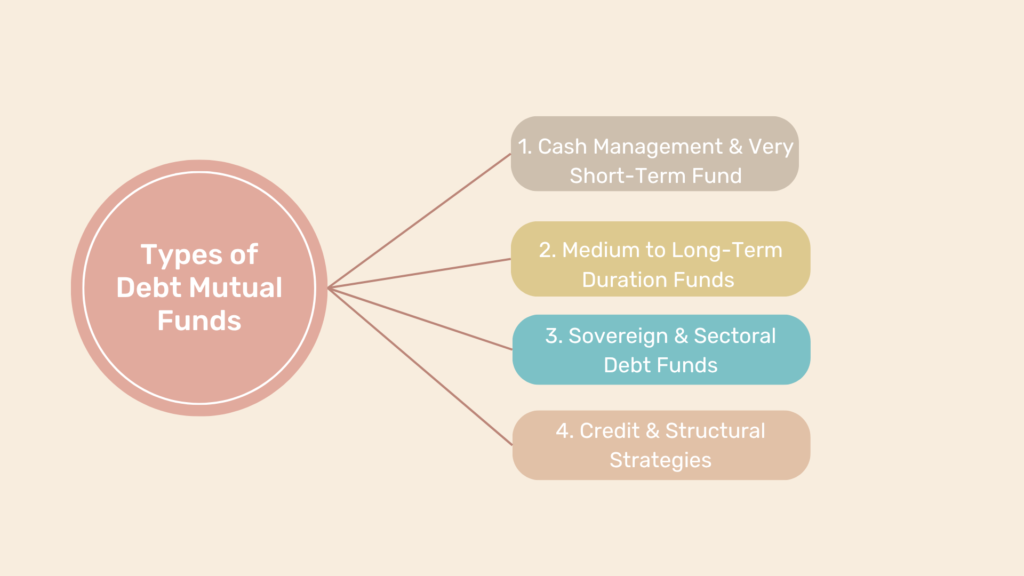
Detailed Classification of Debt Mutual Fund Types
Under SEBI regulations, debt schemes are divided into 16 standardized categories. These group logically into four structural families:
1. Cash Management & Very Short-Term Funds
These funds serve as alternatives to savings accounts and short-term bank fixed deposits, focusing on high liquidity and near-zero duration risk.
- Overnight Funds
- Portfolio Profile: Invests exclusively in debt securities with a maturity of 1 day (such as Tri-Party Repos / TREPS and overnight reverse repos).
- Risk & Dynamics: Practically zero credit and interest rate risk. NAV fluctuations are virtually nonexistent.
- Best Suited For: Parking institutional or corporate surplus cash for a few days up to a week.
- Liquid Funds
- Portfolio Profile: Mandated to invest only in securities with a remaining maturity of up to 91 days (Commercial Papers, Certificates of Deposit, Treasury Bills).
- Risk & Dynamics: Very low interest rate risk. SEBI enforces a tiered graded exit load for withdrawals within the first 7 days to discourage hot-money churn.
- Best Suited For: Stashing emergency funds, managing operating cash, or initiating a Systematic Transfer Plan (STP) into equity funds over a 1–3 month horizon.
- Ultra Short Duration Funds
- Portfolio Profile: Invests in debt and money market instruments such that the portfolio’s Macaulay duration is between 3 to 6 months.
- Risk & Dynamics: Marginal duration risk compared to liquid funds, offering slightly better yields by taking on short-maturity commercial paper.
- Best Suited For: Capital deployment with a planned holding period of 3 to 6 months.
- Low Duration Funds
- Portfolio Profile: Maintains a portfolio Macaulay duration between 6 to 12 months.
- Risk & Dynamics: Holds a mix of short-term corporate bonds and money market paper. Price volatility remains low while capturing short-end yield accrual.
- Best Suited For: Short-term financial goals with an investment horizon of 6 to 12 months.
- Money Market Funds
- Portfolio Profile: Invests exclusively in money market instruments (CPs, CDs, T-Bills, Call Money) with a maturity up to 1 year.
- Risk & Dynamics: Highly liquid, stable credit quality, and minimal duration sensitivity.
- Best Suited For: Low-risk investors seeking stable accrual over a 6 to 12-month period without taking exposure to longer corporate bonds.
2. Medium to Long-Term Duration Funds
These schemes hold longer-maturity paper to generate capital appreciation when interest rates are declining, but they experience visible price volatility when yields rise.
- Short Duration Funds
- Portfolio Profile: Portfolio Macaulay duration between 1 to 3 years.
- Risk & Dynamics: Provides a balance between coupon accrual and moderate duration. Acts as a stable core fixed-income allocation through neutral rate environments.
- Best Suited For: Conservative investors with a 1 to 3-year horizon.
- Medium Duration Funds
- Portfolio Profile: Portfolio Macaulay duration between 3 to 4 years.
- Risk & Dynamics: Higher sensitivity to RBI policy actions. Fund managers often blend corporate bonds with G-Secs.
- Best Suited For: A 3 to 4-year holding period, particularly when interest rates are stable or peaking.
- Medium to Long Duration Funds
- Portfolio Profile: Portfolio Macaulay duration between 4 to 7 years.
- Risk & Dynamics: Substantial mark-to-market volatility. If bond yields rise, capital losses can temporarily erode accrual gains.
- Best Suited For: Strategic, cyclical allocations over 4 to 7 years in an anticipated rate-easing cycle.
- Long Duration Funds
- Portfolio Profile: Portfolio Macaulay duration greater than 7 years.
- Risk & Dynamics: Holds long-dated government securities and infrastructure bonds. Highly sensitive to yield-curve shifts; can deliver strong double-digit gains during aggressive rate cuts, but drops sharply when inflation or yields spike.
- Best Suited For: Institutional investors and specialized tactical allocations with horizons exceeding 7 years.
- Dynamic Bond Funds
- Portfolio Profile: No statutory duration constraints. The fund manager has full autonomy to shift the average maturity dynamically across the entire yield curve.
- Risk & Dynamics: If the manager anticipates falling rates, they lengthen duration (up to 7–9 years) to capture price upside; if rates threaten to rise, they slash duration down to cash or ultra-short paper to defend capital. The primary risk is managerial call error.
- Best Suited For: Investors who want professional navigation of interest rate cycles over a 3 to 5-year period.
3. Sovereign & Sectoral Debt Funds
- Gilt Funds
- Portfolio Profile: Must invest at least 80% of total assets in Government Securities (Central and State Government bonds) across various maturities.
- Risk & Dynamics: Zero credit risk because government paper cannot default under domestic law. However, because gilt holdings are often long-term, duration risk is significant.
- Best Suited For: Investors seeking absolute credit safety who can tolerate short-term NAV swings caused by interest rate changes.
- Gilt Funds with 10-Year Constant Maturity
- Portfolio Profile: Must invest at least 80% in G-Secs such that the portfolio’s Macaulay duration is maintained at approximately 10 years.
- Risk & Dynamics: Serves as a direct proxy for India’s benchmark 10-year sovereign bond yield. Price movements closely follow benchmark bond trades.
- Best Suited For: Long-term fixed-income institutional strategies matching long liabilities.
- Banking and PSU Debt Funds
- Portfolio Profile: Mandated to invest at least 80% in debt instruments of public sector undertakings (PSUs), scheduled commercial banks, and public financial institutions.
- Risk & Dynamics: Exceptionally high credit quality due to implied sovereign/quasi-sovereign backing, paired with moderate duration (typically 2 to 4 years).
- Best Suited For: Risk-averse investors who prioritize safety over high yields for a 2 to 3-year horizon.
4. Credit & Structural Strategies
- Corporate Bond Funds
- Portfolio Profile: Must invest at least 80% of total assets in the highest-rated corporate debt instruments (AA+ and AAA).
- Risk & Dynamics: High credit safety combined with predictable coupon accrual. Minimal default risk, with duration typically managed in the 2 to 4-year corridor.
- Best Suited For: A stable core debt portfolio allocation for 2 to 3 years.
- Credit Risk Funds
- Portfolio Profile: Mandated to invest at least 65% of assets in corporate bonds rated below AA (typically AA, A, or BBB).
- Risk & Dynamics: High credit risk. The fund seeks higher yields (credit spread) and potential capital gains if an issuer’s financial health improves and receives a credit rating upgrade. However, a single default or standstill agreement can result in side-pocketing (segregated portfolio) and substantial capital erosion.
- Best Suited For: Experienced, high-risk investors with a 3+ year horizon willing to accept default risk for higher yields.
- Floater Funds
- Portfolio Profile: Must invest at least 65% in floating-rate debt instruments (or use interest rate swaps to convert fixed coupons into floating rates).
- Risk & Dynamics: When market interest rates rise, the coupon payments on floating-rate bonds reset upward automatically. This hedges the portfolio against capital depreciation during rate-hike cycles.
- Best Suited For: Rising interest rate environments to mitigate duration drag.
Taxation Rules
Under Indian tax laws (applicable to investments made on or after April 1, 2023), debt mutual funds with equity exposure below 35% are treated as Specified Mutual Funds:
- No Indexation Benefit: Indexation (adjusting purchase cost for inflation) is not available.
- Taxed at Slab Rates: All realized gains—irrespective of whether the holding period is less than or greater than 36 months—are classified as short-term capital gains (STCG) and taxed at the investor’s applicable individual income tax slab rate.